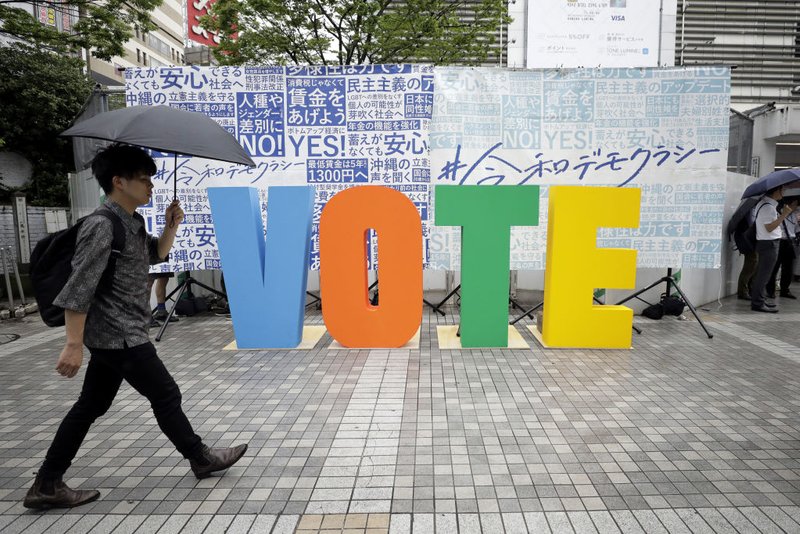
Abe understands that rewriting Article IX and making Japan a “normal nation” by establishing a full military force is impossible. Pacifist sentiments run deep in Japan’s national psyche and even his own coalition partner, the Komeito, would not endorse such a proposal. So Abe has proposed to add a new clause in this article that would affirm the status of Japan’s Self Defence Force. In Abe’s view, recognising the existence of the SDF explicitly legitimises its current role.
But a big question is whether Abe’s LDP and his ruling coalition partner, Komeito, and other political allies can secure enough seats in the upper house to introduce and carry out an amendment to the constitution. (Abe’s coalition and allies have already a two-thirds majority in the lower house.)
The odds are against Abe. That is why he has set a low hurdle for himself in this election. He wants to secure a majority in the upper house by winning at least 53 seats, which added to the 70 uncontested seats will bring the total to 123 in a 245-member house. Any additional seats his party gains will be regarded as icing on the cake.
Abe has deliberately set his target low. In Japan’s 12-yearly cyclic calendar, 2019 is the Year of the Boar, characterised by some unique features in Japanese politics. In the Year of the Boar, Japan typically conducts a quadrennial unified nationwide local election for thousands of local assembly members and heads of local governments a few months prior to the upper house elections.
At the last Year of the Boar in 2007, local and upper house elections proved disastrous for Abe. The then opposition Democratic Party of Japan performed strongly in both the local and the upper house elections. The poor performance of the LDP in the upper house led Abe to resign abruptly a few months later from his first stint as prime minister, after just a year in office.
Fortunately for Abe, his party performed relatively well this year in April’s local elections. But the LDP lost two crucial by-elections for the lower house in the same month, which Abe called “disappointing” before observing that “we have to brace ourselves for the Upper House election”.
Public opinion on constitutional amendment is divided and remains ambivalent. In a survey conducted in 2018, 29% supported change, 27% opposed, while 39% were undecided and five per cent did not respond.
Other issues will also come into play. The Abe government has decided to raise the consumption tax from the current rate of eight per cent to 10% from October this year. Tax hikes are never popular and opposition parties may capitalise on this issue as they are running joint candidates in several crucial seats to fight with the LDP head on.
There are also issues of lingering alleged corrupt practices involving Abe and recent controversy relating to insufficient pension payments has caused a slight decrease in the approval rating for Abe’s cabinet. But Abe and his party remain miles ahead of the largest opposition, the Constitutional Democratic Party.
Returning a two-thirds majority in the upper house seems an uphill task. But elections do spring surprises. If Abe and his allies win a two-thirds majority in both houses, then the Prime Minister will put his foot down to accomplish his long-cherished desire of amending the constitution. This election has the potential to make or break Abe’s dream project.
Purnendra Jain