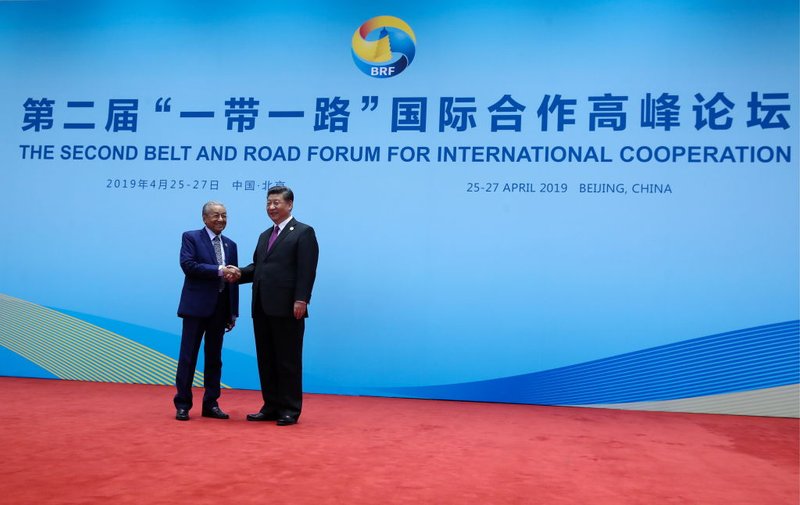
For one thing, Mahathir is an elder-statesman, so his implicit support offers China a chance for a firmer regional footing. Mahathir remains a critic of China’s approach to disputed territory in the South China Sea, but at the very least, having him drop his invective about the BRI will help ensure less regional opposition.
Second, Malaysia’s strengthening relationship with China might rub against the US’s Indo-Pacific strategy. As Mahathir sees China as an economic superpower with great benefit for the Malaysian economy, there is no reason why he would want to be actively involved in a US strategy seen as an effort to contain China’s sprawling influence.
Third, there is an economic consequence, particularly around trade talks. Malaysia has been a big proponent of the centrality of the Association of Southeast Asian Nations, so it is only natural that Mahathir would want to put his support in trade talks behind the Regional Comprehensive Economic Partnership (RCEP), where ASEAN is key.
The RCEP may not be signed anytime soon, but Mahathir is not likely to want to see its demise. RCEP could further facilitate China’s presence in Malaysia as an investment hub for the region. With the US-China trade war, Malaysia could be an export hub for products made in China, but with sufficient local content to overcome objections due to rules of origin.
This ties to a fourth issue. Under Mahathir’s leadership, Malaysia will have its doubts on the Comprehensive and Progressive Agreement for Trans-Pacific Partnership (CPTPP). But this has nothing to do with Malaysia’s new found proximity to China. Mahathir has always had doubts about the US, and Trump’s indecisiveness has not been appealing to the Malaysian leader. In fact, Mahathir had opposed the TPP, and with the US out of the equation, there is less reason to ratify the agreement, especially if the CPTPP is thought to be about containing China. On the substance of the deal, the government is disturbed by issues such as intellectual property rights, investor state dispute settlement and government procurement.
So unlike Najib, who had warm ties to the US while reaching out to China, Malaysia’s tilt to China under Mahathir will mean less support for the US’s initiatives in the region. Not all of this will be a result of China – Mahathir has his own views and domestic considerations – but he will no longer be a strong voice against China’s new colonial tendencies or the dangers of China’s debt-trap diplomacy. In that sense, the world may have lost its last non-aligned leader.
Shankaran Nambiar