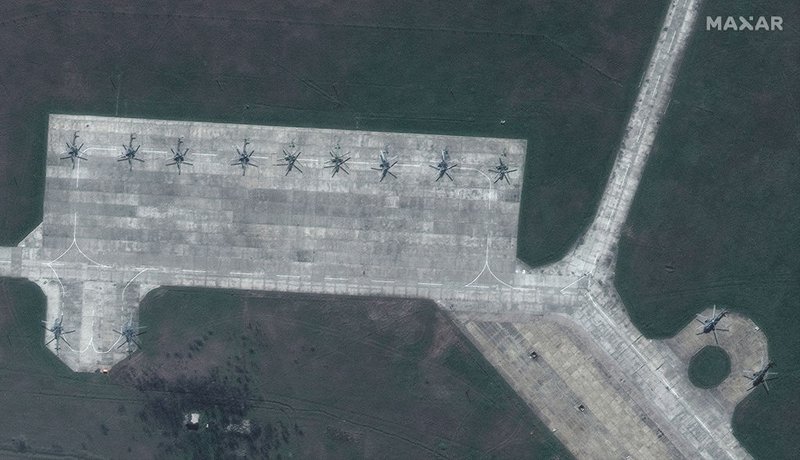
The decreasing cost of satellites, and the improved data quality they provided, led to dozens of firms competing for market share, driving down prices such that today anyone with a few hundred dollars can order imagery of a quality once was reserved for national security. And with some 2000 further imaging satellites coming, yet more and better data will be available at ever cheaper prices.
Similarly, in 2014 around 1.5 billion people had a smartphone. Today, 6.6 billion such devices are in use, meaning about 84 per cent of the world’s population are potential intelligence collectors, with the four billion active mobile social media users able to immediately distribute information.
What do these developments mean for military operations – especially major ones involving much materiel? Overall, the veil of high-level secrecy is likely gone for good. Any point on the world can be imaged, for a pittance, multiple times per day, rain, hail or shine. And while satellites still need know where to look, how likely is concealment in a world with billions of phones, the internet, and OSINT communities scouring all types of media for hints of new activity?
Of course, nations might ban the photography of any military activity, but this would seem difficult to enforce due to the sheer scale of the problem. And while decoys and camouflage have a long history in thwarting IMINT the extent of surveillance (orbital and personal) will make effective deception more difficult, especially for equipment movements of any size.
Alternatively, countries might seek to temporarily blind satellites that pass over them. But this risks contention with asset operators and requires advanced technologies to know which satellites are where, and to precisely control energy beams. Also, nations could request that imagery providers blur sections of their countries. But this incites the Streisand effect, and would companies in competing states always agree, noting OSINT allows officials to publicly discuss security issues without revealing classified intelligence?
Perhaps the most that can be said with certainty is that concealment, and implausible deniability, will become more difficult. And in a world of otherwise increasing disinformation, this might just help stop some conflicts before they start.
Victor Abramowicz