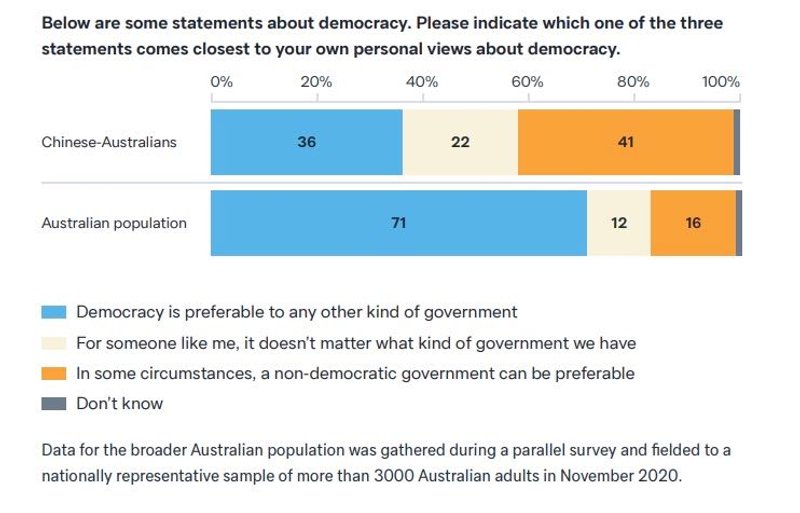
Utilising the 2013 Australian Electoral Studies data, Jill Sheppard and colleagues found China-born Australians, compared to all other migrants, have higher rates of political participation. This context tells us that Chinese-Australians – in fact, immigrants from non-democratic countries more generally – continue their political learning, and in the case of Chinese-Australians, seek to project their political voice once settled in Australia.
While early socialisation is an important point to consider regarding survey respondents’ perception of China’s authoritarian system, sources of information and news are perhaps equally important in reinforcing an individual’s support for democracy. The survey indicates that the use of social media, in particular WeChat, China’s most popular multipurpose social media platform, is an important source of both English- and Chinese-language news. However, 84% of respondents used WeChat regularly to get their Chinese-language news, compared to 64% for English-language news.
Chinese-language media based in China is also a significant source of news and information for the respondents. These findings suggest that the source of news as derived from WeChat (where censorship routinely occurs if it is out of line with the views of the Chinese Communist Party), despite being available and used globally, is likely to shape the respondent’s perception of democracy. Although outside the scope of the survey, the state of Chinese-language media in Australia is lacking in locally produced content and rarely offers Chinese-Australians’ perspectives, thus affecting the lives and choices of migrants.
Context therefore matters. The report highlights the diversity of experiences of Chinese-Australians, as well as their views on Australia-China relations, systems of government, discrimination, attitudes to life in Australia, media habits and other issues.
But in this politically charged landscape around bilateral relations, caution and nuance are crucial, because without them we fall into the dangerous territory of fanning the embers of anti-Chinese sentiment.
Jennifer Hsu