
Defence & security, explained.
Defence & security, explained.
The most-pressing world events explained by Lowy Institute experts and global contributors, in your inbox, every Thursday.
You may unsubscribe from The Interpreter at any time. For information on our privacy practices and how to unsubscribe, see our Privacy Policy.
Hegemon: Wargaming the South China SeaHegemon: Wargaming the South China Sea
Hegemon is a wickedly interactive multi-player/multi-round geostrategic game devised by the Potomac Foundation. Each player represents a country, fielding certain economic and military resources and possessing (secret) objectives.
Ranged across a gods-eye planetary gameboard, Hegemon is the 'softwar' wild-child born of hardcore videogamers and grizzled defence planners. Don't be fooled by its simplistic initial game conditions; things get tricky, fast. Just as in real life, events build upon themselves like fractals. Players bluff and second-guess others' intentions, alliances are formed and broken and decisions need to be made in a fog of uncertainty.
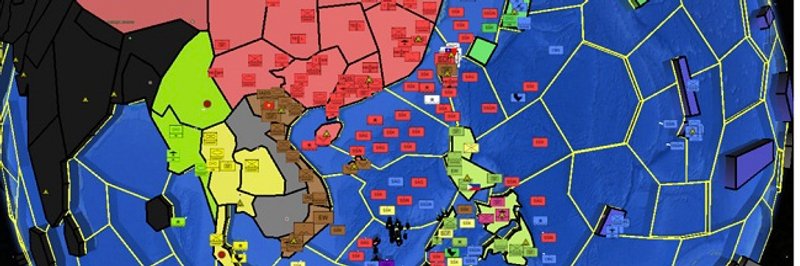
A screenshot of Hegemon: Rise of China, by The Potomac Foundation.
This northern summer's Hegemon simulations centered on the South China Sea. Every game unfolded differently, but the world has a certain ineluctable logic of strategy imposed by objectives, facts on the ground and political will: great powers gonna do great-powering. China looms ever-larger on the South China Sea gameboard tiles; it has the initiative. Because some players secretly fear war and others do not, Hegemon becomes a test of wits where every player suffers from information asymmetry, never sure how their counterparts will react.
Prediction is hard, to paraphrase Niels Bohr, especially of the intentions of other people.
Ten key takeaways from Hegemon: [fold]
Julian Snelder
About the author
Julian Snelder
Julian Snelder is a Kiwi who has resided in Asia for almost a quarter-century.


