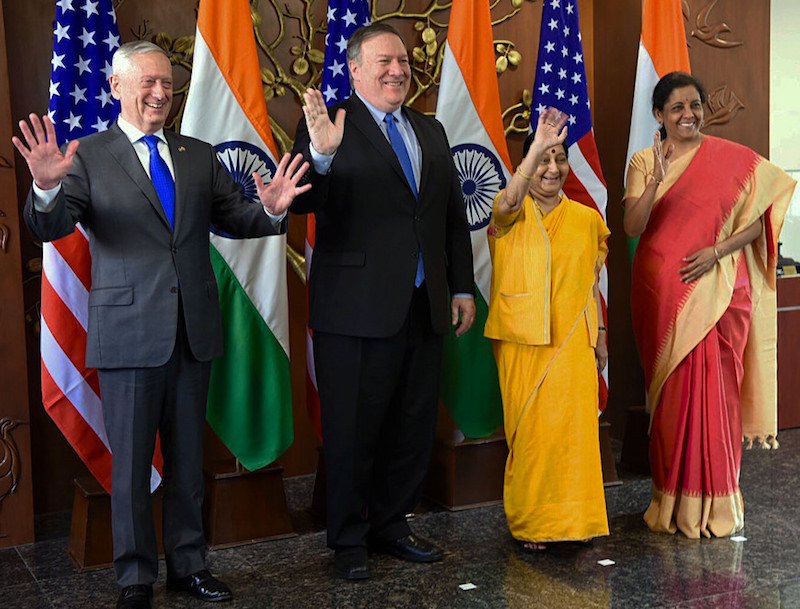
India and the US have signed a Communications, Compatability and Security Agreement, enabling the US to provide India with communications equipment and technology. India had earlier objected to this agreement, concerned with sharing of critical information and its sensitive strategic communications network.
Notwithstanding the recent enthusiasm, there also exist potentially significant spoilers for the partnership.
Reports of US President Donald Trump’s mimicking the speech of the Indian Prime Minister Narendra Modi, and a frosty meeting between the two in Manila in November last year, present something of a personal hurdle. And at a strategic level, India’s need to balance its interests between the US, China, Russia, as well as maintaining relations with regional partners such as Iran, are also a significant factor.
While critical of China at the domestic front, Modi has been reluctant to take a tough line on China at international forums, disappointing many during the Shangri-la summit in June.
Outside Asia, the American influence in India’s Iran policy also has been a factor previously and a new set of sanctions penalising India for trade with Iran (as a major source of oil imports for India) could trigger another balancing act.
While India has asked for waivers, and Pompeo said during his visit to New Delhi “our effort here is not to penalise a great strategic partner like India,” he seemed to leave little room for exemptions. Pompeo declared:
The sanctions with respect to Iranian crude oil will be enforced … and it is our expectation that the purchases of Iranian crude oil will go to zero from every country, or sanctions will be imposed.
India could find itself on the end of US sanctions for its ties to Russia too. The US has objected to India’s planned $6 billion purchase of S-400 anti-aircraft missiles from Moscow and called for the deal to be cancelled – a demand India has so far resisted.
Despite these obstacles in the relationship, the Indian media was pleased that the talks resulted in pressure on neighbouring Pakistan. The joint statement called for a crackdown on cross-border terrorism, reflecting signs of tension between the US and Pakistan over financial assistance. Despite this, however, Pakistan is crucial to American operations in Afghanistan.
While the India-US relationship moves forward, encouraged by the success of the dialogue, particularly from the American perspective, the impact of these spoilers and India’s balancing act is likely to create significant tensions. Trade sanctions will be particularly detrimental to a struggling Indian economy and deterioration of relations with either Russia or Iran could significantly hamper India’s regional position.
There is plenty more to talk about.
Stuti Bhatnagar