Some US commentators and think tanks have been highly critical of this decision, in a way that reveals why China might have taken the opposite view. A 2015 report by the Center for New American Security calculates that if the US Navy replaced its mainstay carrier-based combat aircraft, the Super Hornet, with a UCAV rather than an equivalent crewed aircraft, the savings are likely to be in the vicinity of US$100 billion. That’s because, while UCAVs are unlikely to be any cheaper to buy, they will be significantly cheaper to operate over their lifespan. With pilots flying remotely rather than from the cockpit, training can be conducted almost entirely in the simulator, meaning fewer flight hours, fewer crash replacements, and no need for a fleet of training aircraft.
So on cost alone, the case for UCAVs is attractive. But are they as good? Can they do what crewed combat aircraft can do? Not everything, but the range of missions UCAVs can achieve is expanding, and there are some obvious things they are already better at.
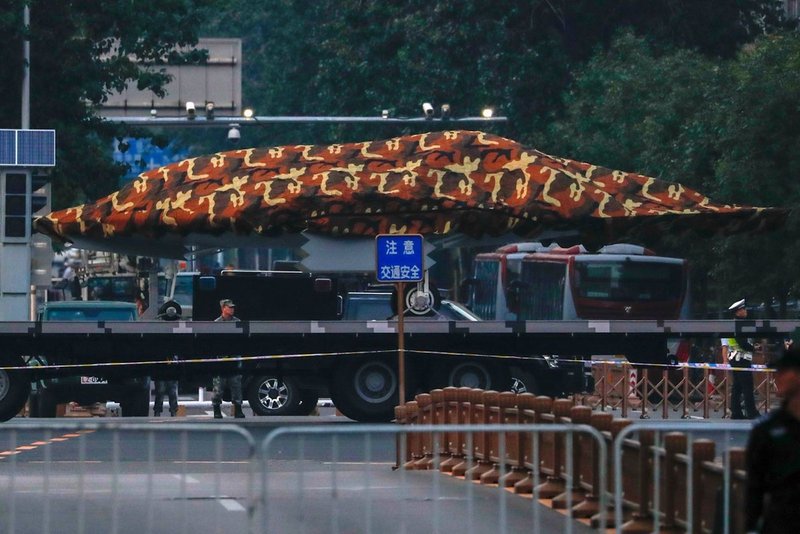
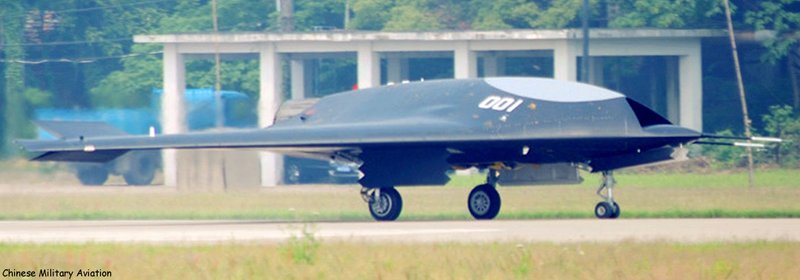
Most notably, drones have greater range (the space taken up by the air crew and the myriad systems needed to keep them alive can instead be used for fuel) and they have persistence. Crewed combat aircraft are restricted by the endurance of the air crew, but it is possible to imagine a UCAV such as Sharp Sword loitering over a target area for hours at a time, retreating briefly in order to refuel from an aerial tanker, and then returning to the combat area, over and over again for 24 or even 48 hours before needing to land.
That represents a major leap in capability because any single UCAV is going to be able to spend much more of its time in combat than an equivalent crewed aircraft. So either you can buy fewer UCAVs for the same combat power, or the same number and get much more combat power.
What’s the message for Australia?
Well, if we are serious about defending the Australian continent against a sophisticated adversary such as China, we may need to rethink our assumptions about the kind of aerial threat we will face. Hugh White’s recent book How to Defend Australia says that in the worst case, China might project 10% of its air power against Australia, or 200 aircraft.
If those are all crewed aircraft, we can make some assumptions about how long each aircraft could loiter over a target, and thus how much combat power they actually represent. But if, say, half of those 200 aircraft are Sharp Sword UCAVs, those combat-power figures are going to rise substantially. And if, as Tyler Rogoway suggests in this Twitter exchange with me, the crewed fighters can deploy dozens or even hundreds of mini drones over a target area, the problem gets harder still.
It seems clear that in the age of widely deployed Chinese UCAVs, Australia will need to rethink the task of defending our air space.
Sam Roggeveen