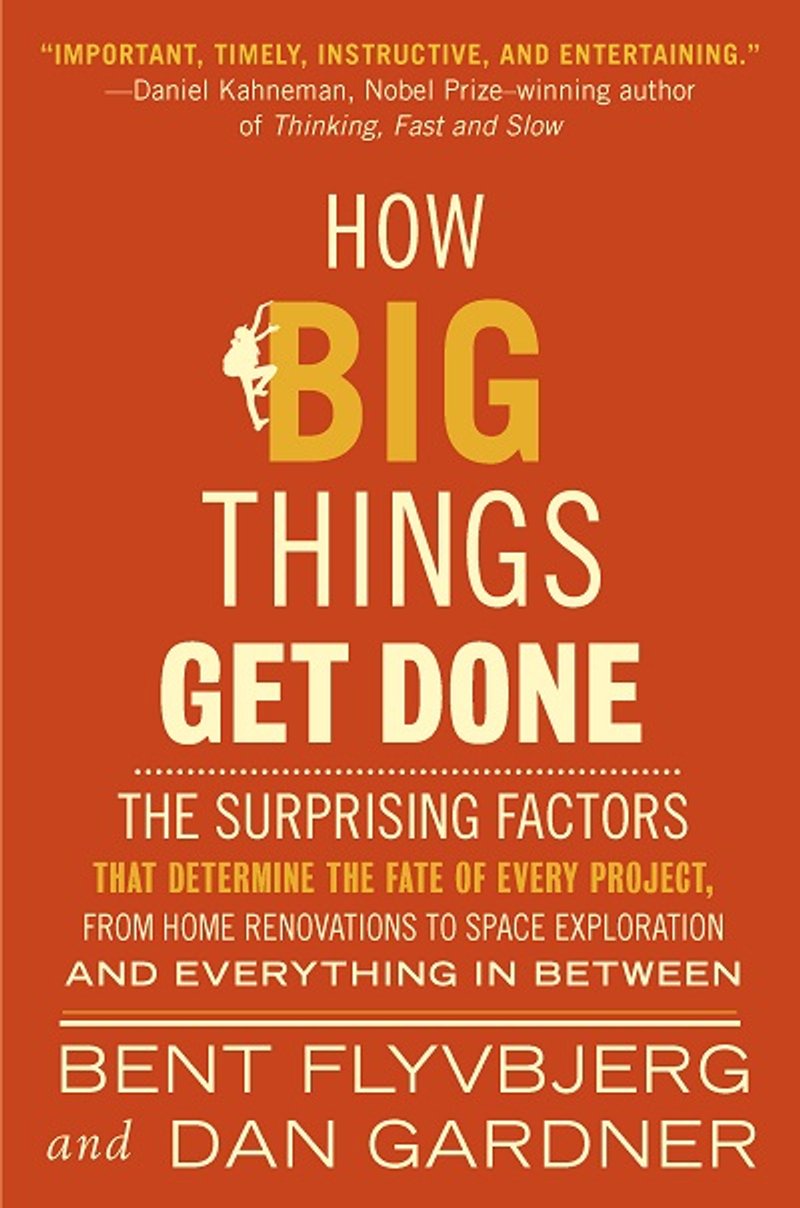
Fifth, do detailed planning beforehand and don’t commit too early (initial construction at the Sydney Opera House had to be demolished). “Think slow, act fast.”
Sixth, beware the “sunk cost” fallacy; sometimes, projects should be abandoned. Learn from failure, including other people’s.
Seventh, combat chronic over-budget cost blowouts by using Reference Class Forecasting. Projects are never as unique as proponents think. Get finished costings of similar projects done elsewhere (the authors’ own database has 16,000 projects). These will compensate not only for the standard optimism bias, but will also include a share of the known unknowns and even Rumsfeld’s unknown unknowns.
Eighth, and perhaps the most interesting, is the authors’ analysis of the degree of difficulty of projects. They rate project types by the distribution of cost over-runs, identifying “fat tails” where the projects not only ran over budget, but dramatically so. At the easy end are solar, wind, electricity grid, fossil-fuel generation, and roads. At the hard end are nuclear, Olympic Games, IT, hydro, and defence. These projects not only go wrong more often, but the blowouts are larger.
These insights have widespread application for Australia, but nowhere more so than in the climate debate and in defence procurement.
If nuclear has any future in the Australian electricity grid, it will be in the form of Small Modular Reactors, rather than large-scale conventional reactors. Australia can wait for others to gain the necessary experience; construction of what was anticipated to be the first commercial reactor has just been cancelled in the United States.
As for the AUKUS submarines, this project breaks every criterion of Flyvbjerg and Gardner: the decision was rushed on political grounds without detailed analysis; Australia has no experience and little established relevant supply-side industry; the technology is very complex with the highest degree of difficulty; and it is bespoke, with little modularity nor opportunities of scale through export.
Main photo from Unsplash user Christian Ladewig.