Subscribe to The Informer for monthly expert analysis, and to Events for advance notice of visiting world leaders and distinguished guests.
You may unsubscribe from Lowy Institute newsletters at any time. For information on our privacy practices and how to unsubscribe, see our Privacy Policy.
External Publications|What do Australians think about the state of the world in 2025? We explain
What do Australians think about the state of the world in 2025? We explain
Hello and welcome back to the Explainer newsletter.
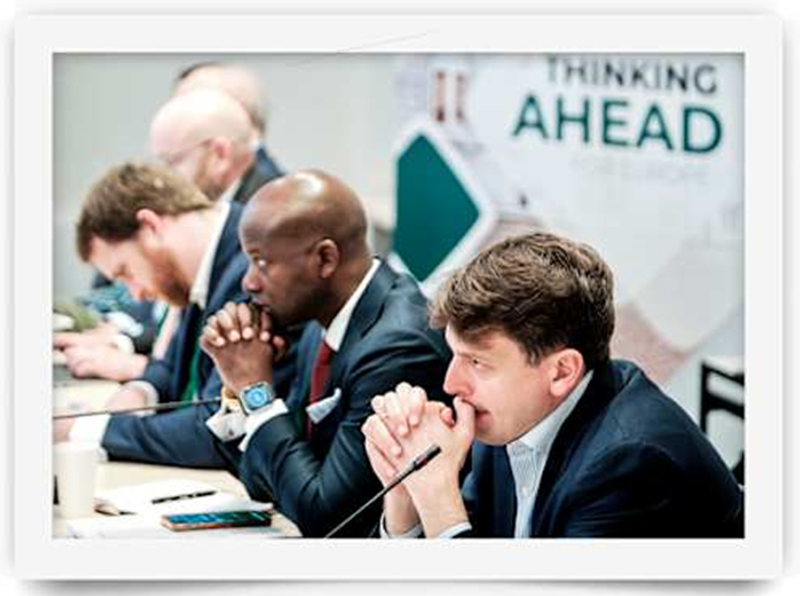
Readers, it’s a year now since we heard from Hervé Lemahieu. Hervé, some of you might recall, is a Belgian-born analyst of world affairs who grew up in South Korea, Barbados and Myanmar (his dad worked in development and counter narcotics for the United Nations) before finishing his studies in Britain. These days, Hervé is the director of research at Lowy Institute, an independent international policy think tank based in Sydney, and it falls to him and his team to make sense of the intrigues and the power shifts in our region. Which keeps him pretty busy. When I spoke with him recently, he was about to jump on a flight to Singapore for a workshop on “South-East Asia between the superpowers” at the Lee Kuan Yew School of Public Policy. Here he is, below right, in Brussels last year at a meeting of the Council of Councils think tank network, talking about the future of the world order, as you do.
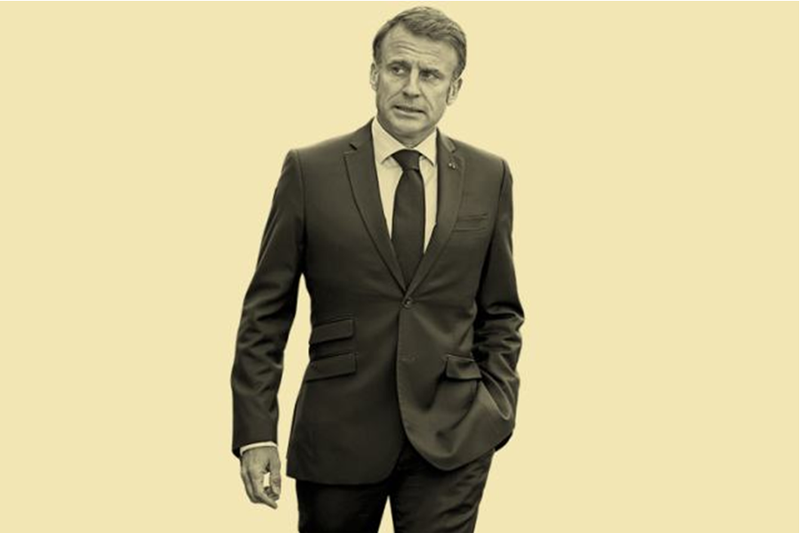
One project of Hervé and his team is to take the pulse of 2000 or so everyday Australians about their views on the world. Their annual Lowy Institute Poll always makes for interesting reading. Who, for example, would you guess are the leaders around the globe in whom Australians have the most confidence to do the right thing in world affairs? Well, you can probably venture who it’s not. Top of the list: New Zealand’s Christopher Luxon (63 per cent). Second: Emmanuel Macron (61 per cent).
Yes, the debonair Frenchman pips our own Anthony Albanese, albeit by 1 per cent. Pour quoi? According to Hervé, distance makes the heart grow fonder. “Australians’ views of Macron are filtered through rosy impressions of the country he leads rather than the bruising realities of French politics,” he told me. (Here’s our explainer on some of those realities, from that time Macron called a snap election that sent France into a total spin. Oups!)
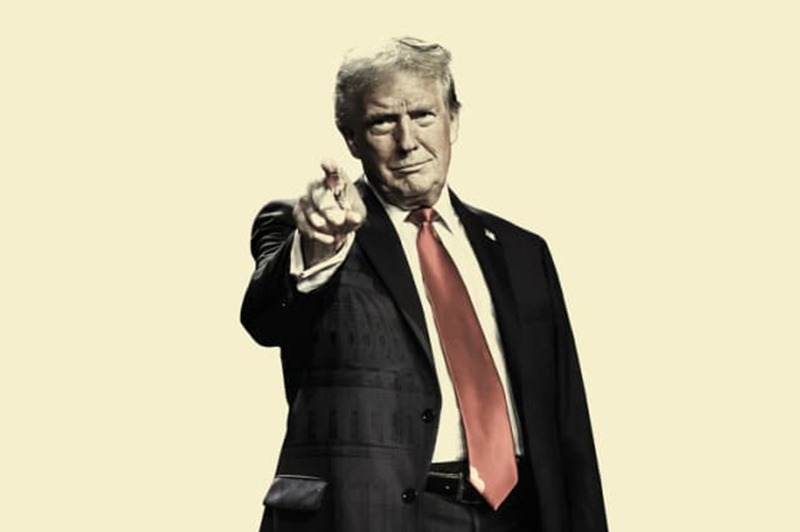
Now, last July in this newsletter I spoke with Hervé about global flashpoints and geopolitical trends. I asked him what subject people asked him about the most at dinner parties and barbecues. His answer back then was: the US election. A year on, Donald Trump is ensconced in his second term and the United States has taken the extraordinary step of “bunker” bombing nuclear enrichment facilities in Iran. Putin’s forces have escalated their attacks on Ukraine, Israel’s military campaign in Gaza continues, tensions recently boiled over between India and Pakistan over Kashmir ... and so it goes. It’s all a lot to digest.
Hervé, is Trump still the hot topic of conversation?
It’s hard to escape him, right? In my circles, because we’re more focused on Asia, I get asked whether Trump has a China strategy. The short answer is, he doesn’t appear to. He went in hard and fast on Europe, he’s in the thick of it in the Middle East. But in the Pacific, apart from a high-stakes tariff escalation and de-escalation with China, his administration has basically been on autopilot. That’s both good and bad.
The “glass quarter full” argument is that the “deep state”, as Trump would refer to it – the Pentagon, the US State Department and Indo-Pacific Command in Hawaii – has more day-to-day control over US affairs in Asia, and Trump has plenty on his plate to keep him busy and distracted. The “glass mostly empty” argument, though, is that Trump’s global trade wars and sweeping aid cuts are haemorrhaging America’s influence in Asia, and the autopilot cannot handle contingency scenarios. How would the United States deal with a Chinese naval embargo of Taiwan, for example? That is a presidential call. But Trump’s settling point on China is a mystery to all, including probably himself.
Yes, last time we spoke, the South China Sea topped your list of hot spots to watch.
Well, if you’re comparing it to a full-scale regional conflict in the Middle East, or to the war in Ukraine, those are much more actual and pressing conflicts, but all the potential flashpoints in Asia continue. What’s perhaps more surprising is that they have not yet turned into more deadly conflicts, especially at a time when other major geopolitical theatres are blowing up. Could US neglect of Asia undermine that relative peace? It’s possible.
When the world’s focus is on one place, it’s a good time to “get things done” in another?
Well, that’s what the Filipinos would be very worried about – that China will test them and test the US alliance, by more aggressively consolidating control of disputed features of the South China Sea when the US is preoccupied elsewhere. The US has repositioned significant assets and aircraft carriers from the Indo-Pacific theatre to the Middle East in order to strike Iran.
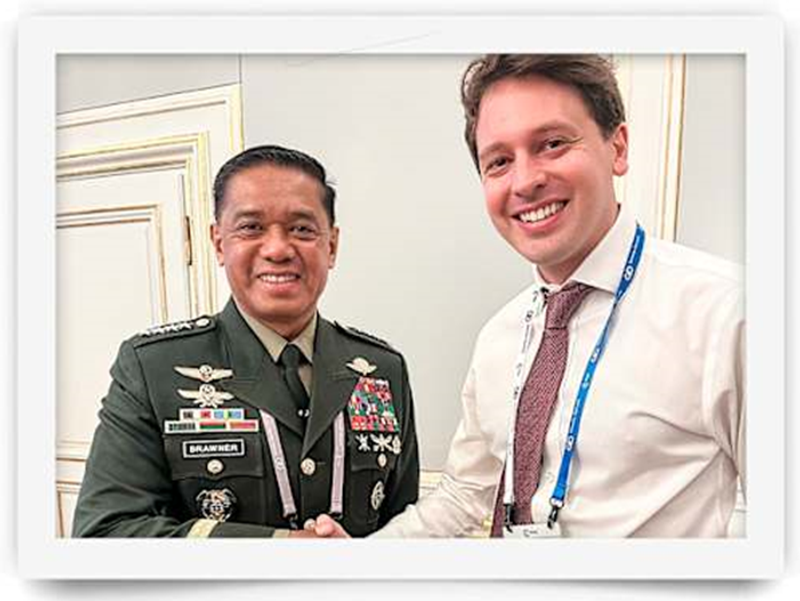
Readers, here’s a photo of Hervé with the chief of the Philippine armed forces, General Romeo Brawner Jr, at the Munich Security Conference in February.
But the interesting question will be, if it turns out the US has been successful in setting back Iran’s nuclear ambitions, if this does lead to a durable ceasefire between Israel and Iran – two very big ifs! – how does that change US force posture? Does it free up bandwidth for Asia? And would a successful show of US military force increase Trump’s risk appetite, or Xi Jinping’s risk aversion? Because, you know, the Chinese are the most devoted students of President Trump, and there are a lot of ways of analysing this, but if they perceive that he is more inclined to use force in his second presidency than he was in his first, it may temper how they pursue their strategic ambitions.
In Europe, you have an arsonist of international rules: Russia, with nothing left to lose. In the Middle East, you have a Hadron Collider effect – multiple players jostling and colliding with each other in search of the upper hand – and there is no strategic balance any more. In Asia, I think the underlying military balance between the United States and China still creates a big disincentive for competition to spill over into outright war. That could change but it would be a huge roll of the dice with uncertain outcomes for the two nuclear-armed superpowers.
No wonder fewer than half of the Australians you polled this year said they felt safe when thinking about world events.
Yes, well, the brakes are off the wheels of global history, and we are heading downhill and picking up pace. The poll captures that moment beautifully, and I think it gives us a good sense that Australians are not only aware of events in the world but they’re also coming up with very calibrated responses. Feelings of safety and economic optimism have both fallen back to COVID-era record lows. But global disorder has also helped restore trust in our system of government. Three-quarters of Australians say democracy is preferable to any other kind of government, equalling a record high in 2022. That suggests to me that Australians know that the good life we have at home can’t be taken for granted, and that we’re increasingly a bit of a life raft in a world adrift.
But that are still quite a few people who want some other kind of government?
Interestingly, of the 15 per cent of respondents who say “in some circumstances, a non-democratic government can be preferable”, Singapore – rather than full autocracies like Russia or China – is most frequently mentioned as coming closest to their ideal.
So, a “guided” democracy?
The challenge with Western liberal democracy across the board, at the moment, is efficacy. That is what Singapore is known for. Look, we’re living through an intellectual pause. There’s economic uncertainty and a lot of anxiety about what the future holds. Many people are feeling that their governments aren’t rising to the challenge. We have to recover a sense of mission. That begins by showing democratic governments can deliver at home.
Just 36 per cent of the people you polled have any level of trust in the US to act responsibly in the world, and 63 per cent think the US would come to our aid if we were attacked. Yet 80 per cent think the US alliance is important to our security. What’s your read on that?
In part, it’s a recognition that there are very few alternatives available to us in terms of alliance partnerships. Europe stands a better chance of becoming more self-reliant from America because they have the numbers and the cross-bracing. But we can’t afford to throw out the US baby with the bathwater. Another way of reading it would be to say, yes, trust in the US has dropped by 20 points in one year – and that is almost entirely Trump-related. But Australians are making a distinction between the man in the Oval Office and the institution of the alliance, which predates him and will hopefully survive him.
You also asked this in your poll: “If Australia were attacked directly by the military of another country, and you were physically capable of doing so, would you be willing to fight to defend Australia?” Three-quarters of men over 45 said yes, but only half of men under 45 agreed. Isn’t that meant to be the other way around?
Well, that question was the result of a dinner party conversation. I had a debate with a politician about exactly what proportion of the population would be willing to help defend Australia if it came to it. We ended up settling the discussion by saying we’d include it in the poll next year.
So, er, should we look out for conscription soon?
I don’t think we ever got to talking about conscription! We were actually talking about what citizenship means in the 21st century, and about people with multiple citizenships. I’m one of them. I’m now a naturalised Australian but I’m also Belgian. The dark hypothetical I asked myself – as an internal litmus test for my worthiness as an Australian citizen – is, would I be willing to risk my life for Australia if it came to it, the way my grandfather did for Belgium three generations ago in the Second World War? It’s not a question that’s ever posed in citizenship applications – nor would I recommend it. It’s morally fraught and difficult to judge without knowing more about the circumstances. An invasion of the continent is, thankfully, still an incredibly remote scenario!
But here’s how I chose to read that intergenerational split: if you pose that question to someone who is older, it would seem much more theoretical, so it’s easier to answer yes. If you’re younger and you’re of fighting age, perhaps it is a bit more real – and your answer is a bit more honest.
Good point. But all of this makes me nervous – we’re still in the first year of Trump’s term.
Yes, but my mantra at the moment is: things are rarely as good as you hope or as bad as you fear. Hard as it is, there’s no point in becoming overly fixated on Trump. There are many variables outside our control in global politics. We can admire the problem. But, ultimately, there are the things we’re going to have to be reactive on, and then there are the things we can be proactive on.
Geography is the one constant. Consider how lucky we are with ours. In our part of the world, there is no Middle Eastern free-for-all, or Cold War-era system of walled division. Responsible middle powers are the majority in Asia and at the heart of its regional institutions. This, too, has a stabilising effect.
So, Australia has to learn to play two games. As a US ally, we have to encourage America, at a minimum, to remain a stabilising military power in the Indo-Pacific. But, as a regional middle power, we too must help sustain and shape a diplomatic and economic architecture of the region that is increasingly post-American. Closer to home, in the Pacific Island region, there is nothing stopping us from a building a more durable and equitable sphere of integration. That is a fully Trump-proof generational project for us, and hugely consequential to our future security.