Foreign Minister Penny Wong at the United Nations General Assembly in New York, 24 September 2026. She has since announced sanctions on four Sudanese individuals and an armed group over the Sudan conflict. (Miguel Gallagher/DFAT)
Australia talks tough on Sudan but won’t confront patrons in UAE
A risk-averse approach to sanctions means Canberra is only going after those inside Sudan responsible for atrocities.
Newsletters
Subscribe to The Informer for monthly expert analysis, and to Events for advance notice of visiting world leaders and distinguished guests.
You may unsubscribe from Lowy Institute newsletters at any time. For information on our privacy practices and how to unsubscribe, see our Privacy Policy.
|Australia talks tough on Sudan but won’t confront patrons in UAE
Australia talks tough on Sudan but won’t confront patrons in UAE
Australia’s (Opens in new window) response to human rights abuses and foreign policy crises is rhetorically strong but risk-averse. Condemnation and sanctions are a good starting point, but more is needed to curb atrocities such as those taking place in Sudan (Opens in new window).
On 5 November, Foreign Minister Penny Wong announced human rights sanctions (Opens in new window) on four Sudanese individuals and financial sanctions on an armed group in response to the ongoing conflict. This was a positive development, and comes on the back of A$67 million in much-needed humanitarian assistance which Australia has given to Sudan since 2023.
But if Australia is going to have meaningful impact on the abuses, it needs to be willing to take stronger actions against all those implicated in the atrocities, both inside and outside Sudan.
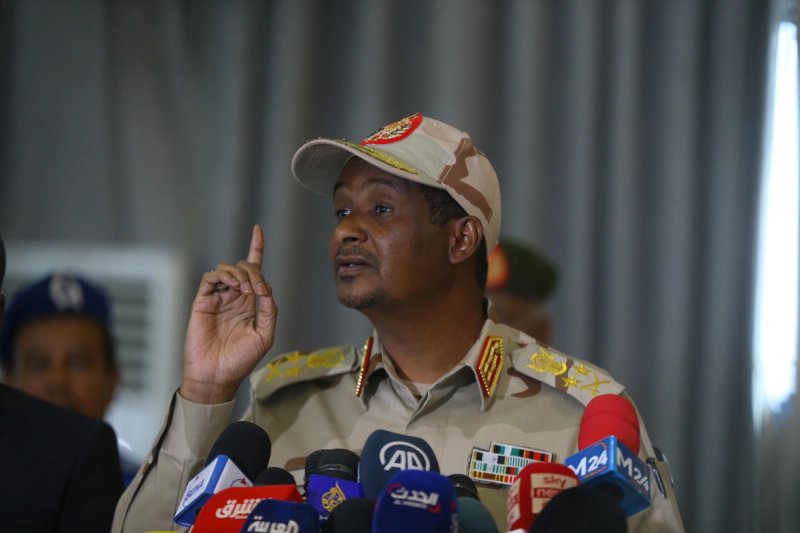
Among those sanctioned was Mohamed Hamdan Dagalo, known as “Hemedti”, commander of the paramilitary Rapid Support Forces (RSF), which is fighting Sudan’s military for control of the country. The only other governments to have sanctioned him so far are Canada, and the United States, under President Joe Biden (Opens in new window).
Sanctioning Sudanese commanders is essential, but it is the least we should expect.
Hemedti’s fighters have been responsible for war crimes and crimes against humanity since the war started in 2023, including egregious crimes in Darfur last year. For 18 months they laid siege to the city of El-Fasher, forcing starving residents to survive on animal feed until even that ran out. During the last days of the offensive in October 2025, the RSF committed multiple massacres (Opens in new window). The UN Human Rights Office estimated (Opens in new window) that over 6,000 people were killed in just three days, and the UN Fact-Finding Mission on Sudan concluded that the campaign bore the “hallmarks of genocide (Opens in new window)”.
RSF fighters also committed widespread sexual violence against women and girls and ran a large-scale abduction-for-ransom operation, killing those who could not pay. In the siege’s final weeks, their drone attacks targeted not only government soldiers and aligned armed groups, but also killed and maimed civilians trapped in a tiny area.
One of the additionally shocking elements to the RSF conduct is that the United Arab Emirates has continued to provide substantial support to the group despite their well-documented crimes. The UAE has provided the RSF with weapons, supplies, and facilitated the hiring of private military contractors. Colombian operatives trained at UAE military bases were deployed (Opens in new window)alongside the RSF on the front lines of El-Fasher, operating drones and artillery. Survivors’ accounts confirm that the contractors were present during some of the worst atrocities.
The UN Fact Finding Mission has confirmed that individuals and entities with links to the UAE “played a significant role in the recruitment, financing, transportation and deployment of foreign military contractors and the provision of military-related support benefiting the Rapid Support Forces.” In aresolution adopted in July 2026 (Opens in new window), the European Parliament criticised the UAE’s support. It called for sanctions on a UAE company involved in recruiting and transferring mercenaries (Opens in new window) to the group.
Australia has remained silent.
The UAE-based Global Security Services Group, which apparently hired the Colombian fighters, has not been sanctioned. Nor is the UAE being held accountable for its military support to the RSF.
Mohamed Hamdan Dagalo, in 2022 before the rift with the Sudanese army that sparked the civil war, in Khartoum, Sudan, 10 August 2022 (Mahmoud Hjaj/Anadolu Agency via Getty Images)
The Australian government should be bolder. The UAE is Australia’s largest trading partner (Opens in new window) in the Middle East. Australia should use that leverage rather than remain silent on UAE support for forces committing war crimes. It should publicly call on UAE authorities to immediately stop providing personnel, arms, related equipment, and assistance to the RSF in violation of the UN arms embargo on Darfur.
Australian authorities should also investigate the role, if any, of the Abu Dhabi-based company, its CEO, and other individuals and entities engaging private military contractors to support RSF operations in Darfur. These investigations should examine possible violations of the UN Security Council arms embargo, with a view to imposing additional sanctions.
According to reporting (Opens in new window) at the end of 2025, Australian companies had exported nearly $300 million in arms and ammunition to the UAE over a five-year period. Australia’s legislation contains no end-use monitoring requirements, so there is no legal obligation to ensure that those weapons do not end up in Sudan.
Given the serious risk that Australian weaponry may be diverted to the RSF, Australia should suspend transfers of military equipment to the UAE, including arms, training, and maintenance.
Sanctioning Sudanese commanders is essential, but it is the least we should expect. It is a politically “safe” option with limited fallout, allowing the government to tell the Australian public that it is acting on Sudan’s atrocities.
The real test of Australia’s commitment to human rights and opposition to war crimes, crimes against humanity, and other atrocity crimes, is whether it will take uncomfortable measures against more formidable actors – including the UAE. The UAE has ample reason to reconsider its support to the RSF if Australia makes clear that it matters.