History is violent, except when it isn’t (Bhautik Patel/Unsplash)
In defence of darkness
Exploring a tradition built on fatalism rather than historical fact.
Newsletters
Subscribe to The Informer for monthly expert analysis, and to Events for advance notice of visiting world leaders and distinguished guests.
You may unsubscribe from Lowy Institute newsletters at any time. For information on our privacy practices and how to unsubscribe, see our Privacy Policy.
Realists tend not to be born apologists. So, it is perhaps telling that Patrick Porter’s punchy, “bite-sized defence of realism”, How to Survive a Hostile World,is strewn with qualifications and disarming gestures.
Yes, he concedes, realism as a framework for understanding international relations is a refuge of the pessimist. And yes, realismhas been tainted by a reputation for cynicism, unscrupulousness, aggression, and violence.
But, Porter insists, the gloomy direction in which the world seems to be heading drags us – if with a sigh – inexorably back to realism and the sombre vision of the world it paints.
“Realism’s main focus is on conflict, power, and survival against the most intense and direct threats”, he reminds us. “Not a trendy topic, perhaps. But alas, once again, on trend.”
It soon becomes clear, however, that the real substance of Porter’s argument is not simply that realism is uniquely helpful in fathoming our dark present, but that it is the best framework for understanding the world, tout court. In making this case, Porter offers three central claims: that realism is “moral”, that realism is “realistic”, and that realism is “for everyone”.Framing his book explicitly as a “defence” of the realist tradition, Porter presents these claims through a series of (often hard-hitting) rebuttals to the dismissive caricatures put forward by realism’s foes.
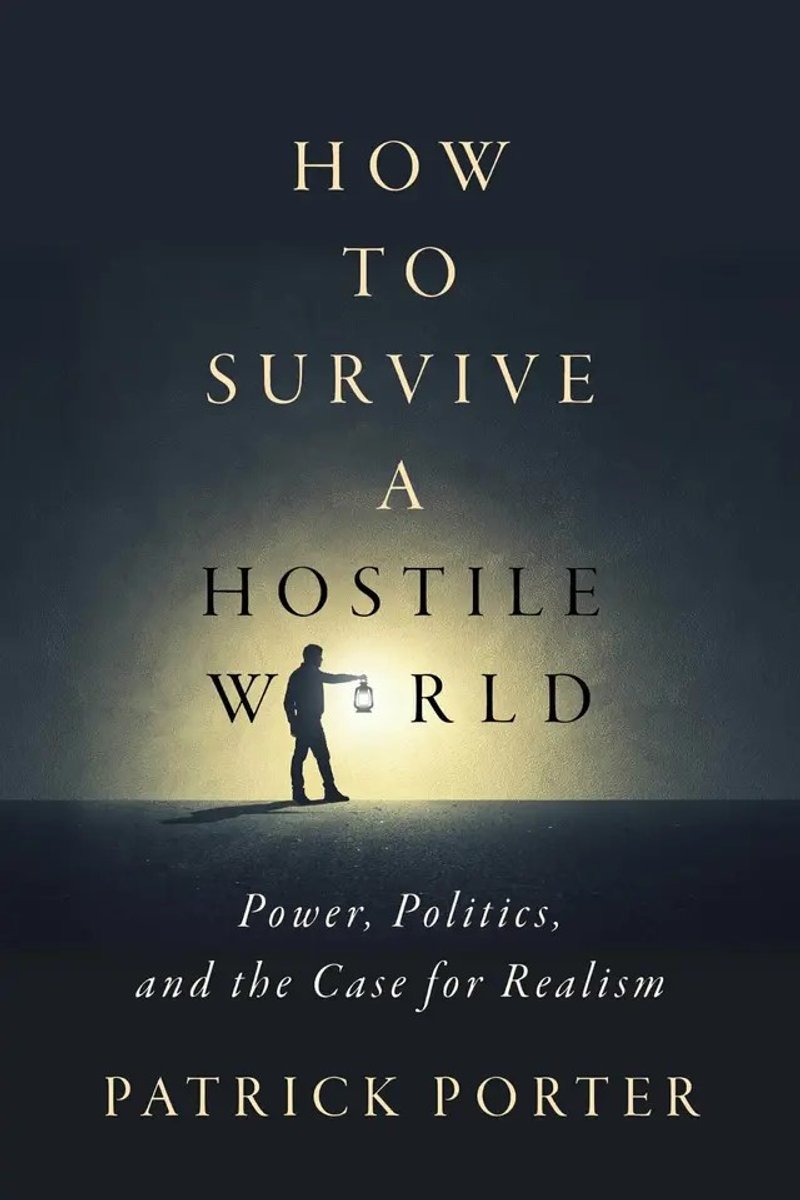
Cover image of Patrick Porter's book, How to survive in a hostile world
As an intellectual enterprise, realism emerges from these pages as a most curious thing. It is not anchored in any anthropological assumption about human behaviour as such: in the realist mind, even a universal will to cooperate could not obviate the need to plan for an anarchic world of rivalry, competition and, ultimately, war. Porter’s position instead reflects a belief in a certain logic of sovereign power. And yet, while this is a conviction derived from a particular understanding of history, it is not, it soon becomes clear, actually rooted in history itself.
Reading between the lines, one sees that the logical problem hinges on the relationship between the prescriptive and the descriptive. “From the ‘is’ – the treacherousness and brutality of international politics – flows an ‘ought’ – that for the sake of the ruled, countries must assume war is possible and they cannot rely on international society or even on long-standing alliances to safeguard them and must look to their own ramparts,” Porter argues. But the further one reads into How to Survive a Hostile World, the more it seems that the book’s message of what ought to be is actually being used to justify what is.
A cut-and-paste distribution of examples from the past hardly suffices to substantiate what is supposed to be, in the end, a theory of history.
The result is a rather selective reading of history. Realism cannot be Eurocentric, we are told, because some non-Europeans have acted like realists. And it cannot be patriarchal, because some women have been realists. Even more fundamentally, it is implied that because the world is periodically violent, it is naturally violent. “The fact remains that history is violent”, Porter writes, before adding in the next breath that, in fact, “most states, most of the time, do not take the risks of launching hostilities”. In other words: history is violent, except when it isn’t.
It might be going too far to describe this kind of approach as history with the history left out. But still, a cut-and-paste distribution of examples from the past hardly suffices to substantiate what is supposed to be, in the end, a theory of history. Perhaps the problem lies not so much in “realist” thinking as such, but in something much deeper: namely, the violence done to reality when trying to grasp global affairs through any grand, all-encompassing “theory”.
One can see the appeal of flattening the irreducible complexity of human activity into a single explanatory schema. After all, a perspective like realism permits us to interpret the behaviour of a foreign state without spending a single second reflecting on the uniqueness of its geopolitical situation, fathoming the specific complexities of its culture, or (God forbid!) studying its language. But if part of the cause of today’s dark global turn stems from the political allure of neat, recipe-book answers to everything, then perhaps that is reason enough to be especially wary of them.
Porter is not blind to this line of attack. But by the time he admits that “No theory – or at least no good theory – promises to capture all the nuances or anticipate every contingency”, or that assuming “that almost all behaviour reflects a realist logic” would “be cheating, making realism indeterminate and unfalsifiable”, the damage seems already to be done. He might rail against the claim of realism’s critics that it is “reductive”, but in the end offers little reason to think otherwise.
To be clear: I do not arrive at this criticism as a dedicated advocate of any of realism’s rival perspectives. Nor do I mean to suggest that this is, as it were, a bad book: Porter is an accomplished scholar, he understands his materials, and he writes with clarity, conviction, and wit. For the most part, he adopts neither a dogmatic nor a haughty tone. His realism is tempered with qualifiers and warnings against the dangers posed by the unthinking extremists who claim to proselytise in its name. And he is surely right that the realist tradition does not warrant the cartoonish portrayal with which it is often ridiculed. As an introduction to realism, How to Survive a Hostile World is a fine contribution indeed.
But in the end, the most persuasive point advanced in this book is not, in fact, the argument Porter explicitly sets out to make. Rather, it is the suggestion that realist thinking is driven less by the historical “fact” of “competitive power politics under anarchy”, and more by a kind of pragmatic fatalism – a Pascal’s Wager of sorts: the conviction that the potential costs of embracing any alternative are simply too high. Surveying the world around us in 2025, few, surely, would disagree.
Patrick Porter, How to Survive a Hostile World: Power, Politics, and the Case for Realism (Stanford UP, 2025)