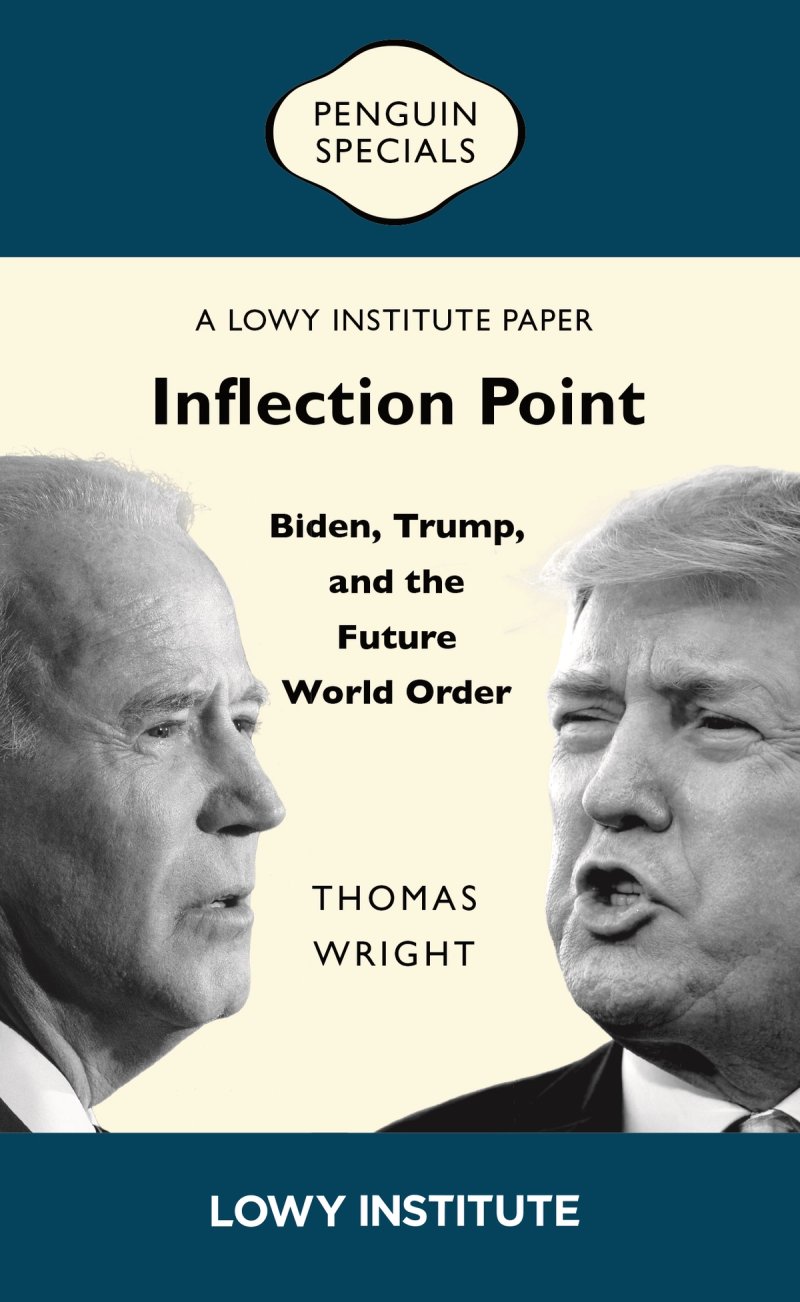
Inflection Point is a Biden administration insider’s account of how global crises were managed under that presidency, and a warning of what is to come. You can buy Inflection Point at any good Australian bookshop or order online.
Hubris
The January 2026 raid that captured Venezuelan leader Nicolás Maduro instilled confidence in US President Donald Trump in the use of lethal force to deliver outsized results. Plenty of people had predicted catastrophe, just as they had predicted it ahead of the June 2025 strikes on Iran’s nuclear facilities, but it did not occur. Trump saw both operations as clear successes. He came out of these episodes convinced that he had developed an instinct for when force would work and when it would not. He felt confident. He was willing to roll the dice.

Shortly after, Israeli Prime Minister Benjamin Netanyahu came to him with the argument that Iran was weaker than it had been at any point since the 1979 revolution – Iranian proxy groups Hezbollah and Hamas had been gutted; the pro-Iranian dictator of Syria, Bashar al-Assad, was gone; there were sustained protests in Iran – and that this was the moment to deal the regime a blow from which it would never recover. Netanyahu also reminded Trump that Iran had tried to assassinate Trump in 2024 and that this was a chance for retribution. Trump was receptive.
Operation Epic Fury, launched on 28 February, was unmistakably a war of choice. The June 2025 strikes had set back not only Iran’s nuclear program but also its missile stockpiles and air defences. The regime was indeed weakened. But precisely because of this, there was no pressing need to act militarily. There was also no urgent need to push for a comprehensive deal. A deal in which Iran gave up its enrichment program would almost certainly have required sanctions relief on a scale that would have provided the regime with an economic lifeline at the very moment its internal pressures were building. Simply staying the course – keeping the pressure on and holding open the option of further strikes if the regime tried to rebuild – was a viable strategy.
It was also, on paper, the strategy one would have expected from Trump. He had run against forever wars and regime change. He promised not to get the United States bogged down in the Middle East. When he struck Iran’s nuclear facilities in June 2025, he declared it “obliterated” and moved swiftly to impose a ceasefire on Israel and bring the war to an end, over Netanyahu’s objection.
The most likely outcome to the war is a settlement that satisfies no one.
But by early 2026 Trump was in legacy mode. He could see the outlines of a quick and historic victory: the regime that plotted to assassinate him in 2024, that sponsored Hezbollah and Hamas, that had been a thorn in the side of successive American presidents for 47 years, might be removed under his watch. The opportunity, the personal element, and the hubris arising out of the Maduro raid combined to override the instincts that had pulled him in the other direction the previous summer.
There was one more piece. In Venezuela, Trump quickly did a deal with Maduro’s deputy, Delcy Rodríguez, to work with the United States. He hoped to replicate the approach in Iran by working with a strongman who would cooperate with him on a peace deal and possibly cut the United States in on oil exploration. Trump showed little interest in backing an exiled opposition figure such as former Crown Prince Reza Pahlavi, and instead told the press that a new leader “from within” the regime “might be more appropriate”. What happened in Venezuela, he told The New York Times, would be “the perfect scenario” for Iran. The campaign was meant to be short. The successor was meant to emerge naturally from a regime under enough stress to break, but not so much stress that there was nothing left to inherit.
None of these assumptions survived contact with the war.
Tactical success, strategic setbacks
The opening days of the February 2026 campaign produced an extraordinary tactical success – the assassination of Ali Khamenei and many of his top associates. But for Trump, it created a problem for his preferred Venezuela-style succession scenario. As he told ABC’s Jonathan Karl: “The attack was so successful it knocked out most of the candidates. It’s not going to be anybody that we were thinking of because they are all dead. Second or third place is dead.”
For Israel, the war would be a failure if the regime survived in any form. Tehran could bide its time, rebuild its missile program, wait for the United States to lose interest, and threaten Israel again. Israel wanted regime change, ideally to a democracy or a more benign government, but it was prepared to accept chaos in Iran, even civil war, as the price of regime destruction.
For the United States and many other countries, state collapse in Iran would be a disaster. It had the potential to flood the region with refugees, energise jihadist movements, draw in Turkey and the Gulf states, and bog down US forces in the Middle East for years, exactly the open-ended commitment that Trump had spent his political career promising to avoid.
Trump went through various stages of grief.
The tension became evident in the administration’s reported plan to arm Kurdish fighters to move against the regime on the ground. At one level, this solved a problem Trump was grappling with – how to affect political change in Iran without committing American troops – but it also came with great risk. The use of the Kurds could antagonise pro-American Iranians (who are also nationalist) and boost the regime. It would anger Turkey, potentially leading to the collapse of its peace process with the Kurds, and it could lead Erdogan to intervene against them. After consulting with the Turks, Trump backed off, telling reporters “the war’s complicated enough without getting the Kurds involved”.
The early operational results were impressive in the way that early operational results often are. The US and Israel destroyed much of what remained of Iran's navy and air force. Many of Iran’s missile systems were eliminated. More senior figures across the regime were killed. Trump began to claim that the war was “already won” and “very complete”. Some leading Republicans, such as Senator Josh Hawley, urged him to declare victory. Trump told Fox News that he would end the war when he felt it “in his bones”.
But the costs began to accumulate in ways for which the administration had not prepared.
Iran immediately expanded the war by hitting over a dozen countries in the region, including the United Arab Emirates, Saudi Arabia, Bahrain, Kuwait, Qatar, Jordan, Iraq, Syria, Oman, and Turkey. Iran targeted US bases but it also struck airports, energy facilities, and data centres, with a particular focus on the UAE. To some, it appeared counterproductive – Iran was uniting the region against it. But Tehran knew that it could not win a limited war against the United States and Israel. It was taking aim at the core value proposition of many of the Gulf states – that they are safe and reliable venues for investment and in some cases tourism. Tehran also hoped that the region would pressure the United States to end the war. Trump was, by his own admission, surprised: “They weren’t supposed to go after all these other countries in the Middle East. Nobody expected that. We were shocked.”
Iran also gained effective control over the Strait of Hormuz, denying transit to allied traffic. Iran was able to use its coastal areas to threaten ships and tankers with rockets and drones. A closure of the Strait had often been gamed out by Pentagon planners but they did not have a ready-made option to open it without the use of ground troops. In an extraordinary twist, Iran was able to keep using the Strait itself to export oil and the United States even lifted some sanctions on Iranian oil to keep it flowing into the market as prices hovered around $100 per barrel. Trump went through various stages of grief. He denied that it mattered at all because the United States does not get oil from the Strait. He blamed others, especially Europe, for not opening the Strait. And ultimately he would accept the closure by imposing a counter-blockade.
The deeper problem, however, was that Iran had absorbed the strikes and adapted. The Islamic Revolutionary Guard Corps (IRGC), far from being broken, became even more dominant than it was under Ali Khamenei. Iran had been facing a succession crisis but the circumstances of the war meant that Mojtaba Khamenei was able to succeed his father without great unrest – partially because he was injured and lost several members of his family in the initial strikes and partially because real power seemed to lie elsewhere, with the IRGC. The regime also quickly came to understand that it had real leverage over the United States, the Gulf, and the global economy more generally.
Trump was puzzled that the regime was not accepting defeat.
Iran was supported, quietly but materially, by China and Russia. China’s largest chipmaker, Semiconductor Manufacturing International Corporation, provided Iran with chipmaking tools and technical training; satellite companies provided real-time imagery of US forces; Iran acquired a Chinese spy satellite and was able to use it to capture images that were used in drone and missile strikes; and China provided Iran with sodium perchlorate, a precursor used for solid missile propellant. Meanwhile, Russia reportedly provided Iran with targeting intelligence, spare parts, missile components, and advanced drones. Trump was largely dismissive of both countries’ efforts, saying that the United States also helped Tehran’s and Moscow’s enemies, and that their assistance was not making much of a difference anyway.
Trump in a bind
By early May 2026, Trump confronted a set of choices that ranged from poor to worse. He did not want to fight a war of attrition that could drag on for the rest of 2026 and perhaps longer. But each alternative option had been narrowed by the choices that came before it.
Trump thought about escalating. One option was to conduct a raid on Iran’s nuclear sites to seize its highly enriched uranium. This could provide a spectacular tactical success that would allow him to declare victory and end the war. But such an operation would be extremely difficult to pull off. It would likely require thousands of troops deployed to the site for up to a week, to extract hazardous material from under rubble, transport it out by air, all while under attack. Another idea was to seize Kharg Island, a critical hub for Iran’s oil industry, only giving it back to Iran after it accepts US terms. But US troops needed would find themselves within range of Iranian rockets. A third escalation option was to deploy ground forces to the coastal area of Iran near the Strait to clear out Iran’s military positions but this could lead to a protracted ground war.
Finally, having considered and discounted all of these options, Trump threatened to destroy all of Iran’s infrastructure, including its energy plants and bridges. But this appeared certain to result in Iranian retaliation against the Gulf states’ critical infrastructure, including energy and water desalination plants. On 7 April, Trump posted on Truth Social that “a whole civilisation will die tonight, never to be brought back again”, shocking many of his own supporters. As the clock ticked closer to his own deadline, he agreed to a ceasefire brokered by Pakistan.
The other option was to agree to a deal with Iran, closer to its terms. This would impose limits on Iran’s enrichment program but not abolish it entirely; it would not touch its missile program; it would recognise Tehran’s effective control over the Strait of Hormuz; and it would give Iran full sanctions relief. In the ceasefire announcement, Trump said that Iran’s 10-point plan was “a workable basis on which to negotiate”. Within days he was backing away, and in talks in Islamabad, Vice President JD Vance found that Iran had no intention of accepting US demands on its nuclear program. Trump then imposed a counter-blockade on Iran in the expectation that it would cause the regime to quickly accept his terms. It did not.
The United States had imposed significant military damage on Iran, destroying its navy and air force, much of its missile program, and its defence industrial base. Trump was puzzled that the regime was not accepting defeat. But there is a difference between tactical and strategic success. The regime had survived, which was an accomplishment in itself. It discovered the equivalent of an economic nuclear weapon in its ability to close the Strait of Hormuz. And it was able to hit the Gulf states and Israel with missiles and drones throughout the war, despite the aerial bombardment. In effect, both sides sincerely believed they won and were in little mood to compromise.

The Iran war is a reminder that Trump’s second term is markedly different to his first and that he is willing to take big risks on issues that he believes could build a unique legacy.
The most likely outcome to the war is a settlement that satisfies no one. Either a stronger nuclear arrangement than the 2015 Joint Comprehensive Plan of Action, but one that involves sanctions relief and leaves Iran’s missile program untouched and the regime intact; or an arrangement closer to the offer Iran tabled in late April in which the Strait reopens and nothing else is settled.
The consequences for MAGA
The World Bank estimates that the Iran war may already be the largest ever oil supply shock. If the war drags on, the costs will mount. The brunt of it will be felt in Asia, the destination for 80% of the oil that flows through the Strait of Hormuz. There are soon likely to be shortages of key commodities, including petrochemicals and fertiliser, not just a spike in price. The United States is relatively insulated from this shock compared to some of its allies, as is Israel, but there will be upward pressure on the price of energy and inflation more generally. That is bad news for the Trump administration and Republicans as they head into the 2026 mid-terms.
Trump’s decision to go to war against Iran alienated many of his most ardent high-profile supporters, including media figures Tucker Carlson and Megyn Kelly, but his approval ratings among Republicans and the Make America Great Again (MAGA) movement remain high. Trump has long claimed that MAGA means whatever he says it means, but the war may spark a rebellion as the 2028 primary approaches. Media reports have recounted Vance’s opposition to the war within the administration, which could give him an advantage over another likely candidate for the Republican presidential nomination, Secretary of State Marco Rubio. But Vance is in a difficult spot, unable to criticise Trump directly and forced to defend something he doesn’t believe in.
The war is also likely to undermine political support for the US-Israel alliance among Republicans, particularly if it drags on and is perceived to go badly. Early in the conflict, Rubio told the press that the United States was compelled to strike Iran because Washington knew an Israeli strike was imminent and that Iran would retaliate against American forces.
Above all though, the Iran war is a reminder that Trump’s second term is markedly different to his first and that he is willing to take big risks on issues that he believes could build a unique legacy. These actions will have outsized geopolitical consequences. The Middle East will be different after this war ends. There may well be other shoes to drop in the next two-and-a-half years.