A set direction? (Igor Kyryliuk & Tetiana Kravchenko/Unsplash)
In the mirror of the future
Assessing a world of shifting alliances and nervous great powers.
Newsletters
Subscribe to The Informer for monthly expert analysis, and to Events for advance notice of visiting world leaders and distinguished guests.
You may unsubscribe from Lowy Institute newsletters at any time. For information on our privacy practices and how to unsubscribe, see our Privacy Policy.
Today’s world, argues Odd Arne Westad in The Coming Storm, is one “where multiple Great Powers” have come to “jostle for supremacy”. It is a world driven by conflicting interests and marked by fragile and ever-shifting alliances and friendships. Mistrust and fear at the geopolitical level are exacerbated by the disorienting and accelerating effects of new technologies, with the upshot that horizons of decision-making are exceedingly narrow – and seemingly narrowing further. It is, in short, a world that more resembles Europe on the eve of the First World War than any geopolitical constellation we have witnessed since.
Setting out from these premises, The Coming Storm does three things: it surveys a world rich in conflict potential; it foreshadows the circumstances in which a hypothetical war between the Great Powers may be ignited; and it holds up to the present the dark mirror of 1914.
As a Norwegian working in the United States, Westad’s background as both a Sinologist and leading authority on the global Cold War equips him ideally with the expertiseand breadth of vision required to produce this type of analysis. For such a brief book, he is able to cover a formidable expanse of territory.
It is no surprise that, as a historian, Westad is drawn to the grim example of the First World War.Among scholars, no event – bar none – has generated quite as much heat, disagreement, or indeed sheer volume as the outbreak of hostilities in Europe in 1914. Though the Second World War remains the envelope from which we draw so much of our political vocabulary, it is the origins of its predecessor that continue to supply the historical catastrophe par excellence for policymakers. It is the nightmare from which we cannot – and in Westad’s view, should not – awake.
Disaster must not always be the result of excessive stresses in the fabric of the international system – it may just as easily be triggered by accident, misunderstanding, or the reflex action of the deformed mind.
Westad paints his parallels in very broad brush strokes. Today’s America, the nervously declining global power, roughly occupies the place of Britain before 1914. Germany, the entitled and paranoid parvenu, becomes China (with Deng Xiaoping playing Bismarck). Putin’s existential drive to preserve his country’s sphere of influence renders Russia the new Austria-Hungary. India, a “touchy great power”, assumes the role of France.
It would be tempting to criticise these appraisals for their base superficiality. But that, I think, would miss the point. For Westad’s purpose in The Coming Storm is not to draw analytical links: his standpoint is not one of rigorous, transhistorical examination, excavating deeper structures, laws and patterns so as to confer explanatory substance upon the analogies he offers. The book is engaged in parallels, not comparisons. It is rather as if Westad’s two worlds are warily watching one another across the decades. They circle around one another, circumspect yet deathly curious, unsure whether the object of their gaze is a mirror or an alien body.
Once we grasp the register at which Westad offers his parallels, his portrait of 1914 does indeed prove highly instructive. For historians, one fascination of the First World War’s outbreak consists in the potency with which it illuminates the perennial explanatory conflict between the forces of structure and agency. Had the will been sufficiently resolute in 1914, European statesmen hardly lacked the latitude to ensure peace. But they nevertheless acted under an enormous weight of pressures and constraints, often utterly invisible to them. These influences were local as well as abstract. Domestic power structures, codes of honour, biographical narratives, and political logic bore down on their decision-making as much as the impersonal forces of imperialism, nationalism, geopolitical rivalry, or the risk-escalating logic of arms races and deterrence policies.
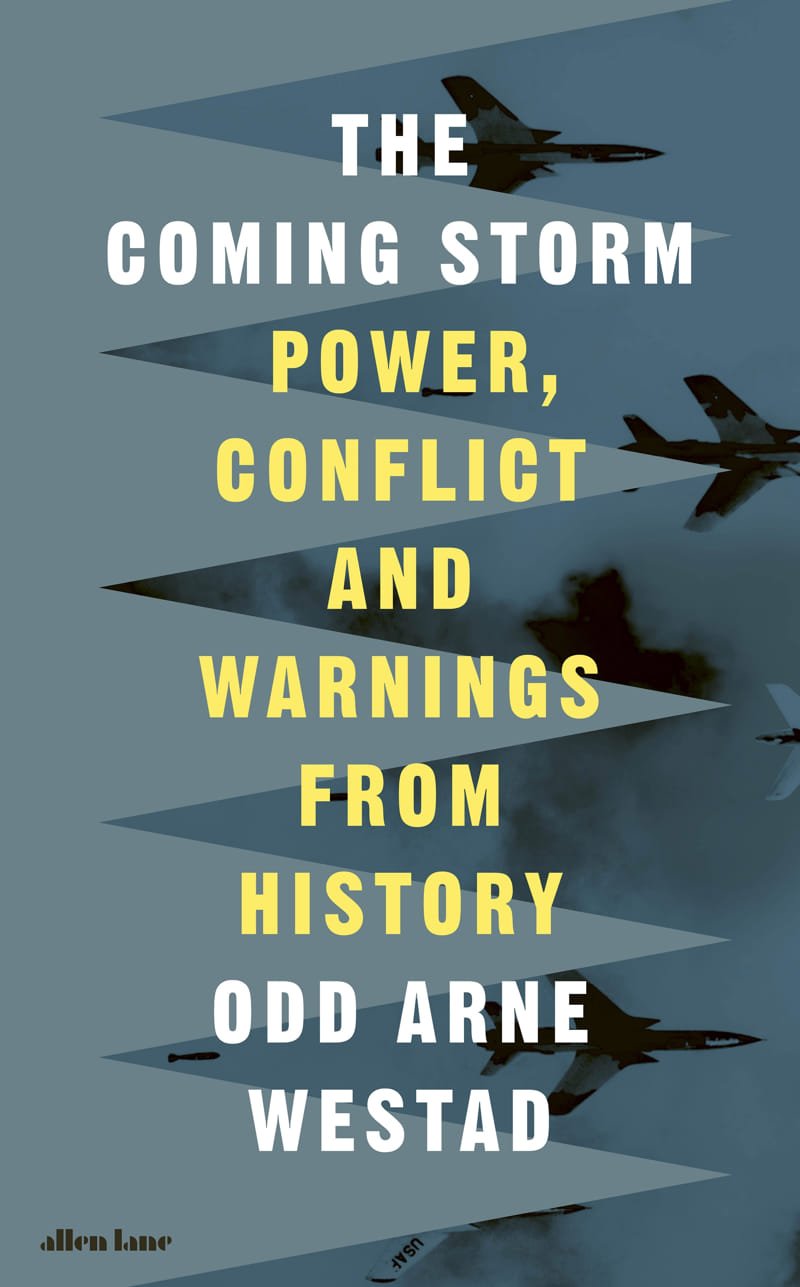
Odd Arne Westad The Coming Storm cover
The cross-entanglement of these factors supplies the unfathomably intricate historical map that generations of scholars have had to navigate. When surveying our uneasy world today, the case of 1914 ought therefore to dissuade us from seeking simple explanations for conflict potential, be they in the form of economic reductionism or in pseudo-psychological assessments of individual leaders.
Westad is attuned to these nuances, and as a consequence is able to offer some helpful insights.He is surely right, for example, to point to the prominent position occupied by values in accounting for the complex behaviours of international actors. Hubris and fear, the author reminds us, are explosive emotions when felt in the minds of egotistical holders of power. As 1914 revealed, catastrophe can swiftly result when such leaders “fear the perception of weakness more than they fear the consequences of war”.
As any student of the July Crisis is only too aware, personality, too, is no marginal factor. Disaster must not always be the result of excessive stresses in the fabric of the international system – it may just as easily be triggered by accident, misunderstanding, or the reflex action of the deformed mind. Hence, when it comes to prescribing his “case for peace”, Westad is emphatic that world leaders should “know each other” and “show each other respect”.
But perhaps the critical theme is the power of change itself. One of Westad’s most compelling arguments concerns the propulsive role played by the speed of global transformations in eroding the capacity of leaders to make decisions in their own medium-term interest – then as now. Not only did the disruptive effects of new technologies compel Europe’s early 20th century leadersto valorise rapidity and decisiveness (in politics as well as on the battlefield), they also had an alienating effect on their populations, producing an explosive atmosphere, as Westad observes, of “intensified fears, resentments, and conspiracy theories”. Ultimately, the cult of speed is a self-destructive one. As the author wisely cautions:
“For China and other rising Great Powers, who are in a hurry to erode US positions, the historical evidence is that it would be in their own best interest if such processes took place over time rather than within a short period.”
In the final chapter, “Causes of War”, Westad casts his searchlight over the world’s trouble spots and elaborates for each the hypothetical chains of events that might conceivably suck the Great Powers into a global conflict (today’s potential Serbia, to maintain the 1914 analogy). It is an alarming read, to be sure. But Westad’s tone is not alarmist. Rather, his coverage remains sober, judicious and well-informed throughout; the spectre of 1914, after all, is a “warning from history” – not a projection of fate.