Former prime minister Tony Abbott speaks during the Australian Liberal Party annual meeting on 29 May 2026 in Melbourne, Australia (Asanka Ratnayake/Getty Images)
Reading Abbott’s Australia from abroad
The former PM’s sweeping history of Australia doubles as a guide for how outsiders can read the country.
Newsletters
Subscribe to The Informer for monthly expert analysis, and to Events for advance notice of visiting world leaders and distinguished guests.
You may unsubscribe from Lowy Institute newsletters at any time. For information on our privacy practices and how to unsubscribe, see our Privacy Policy.
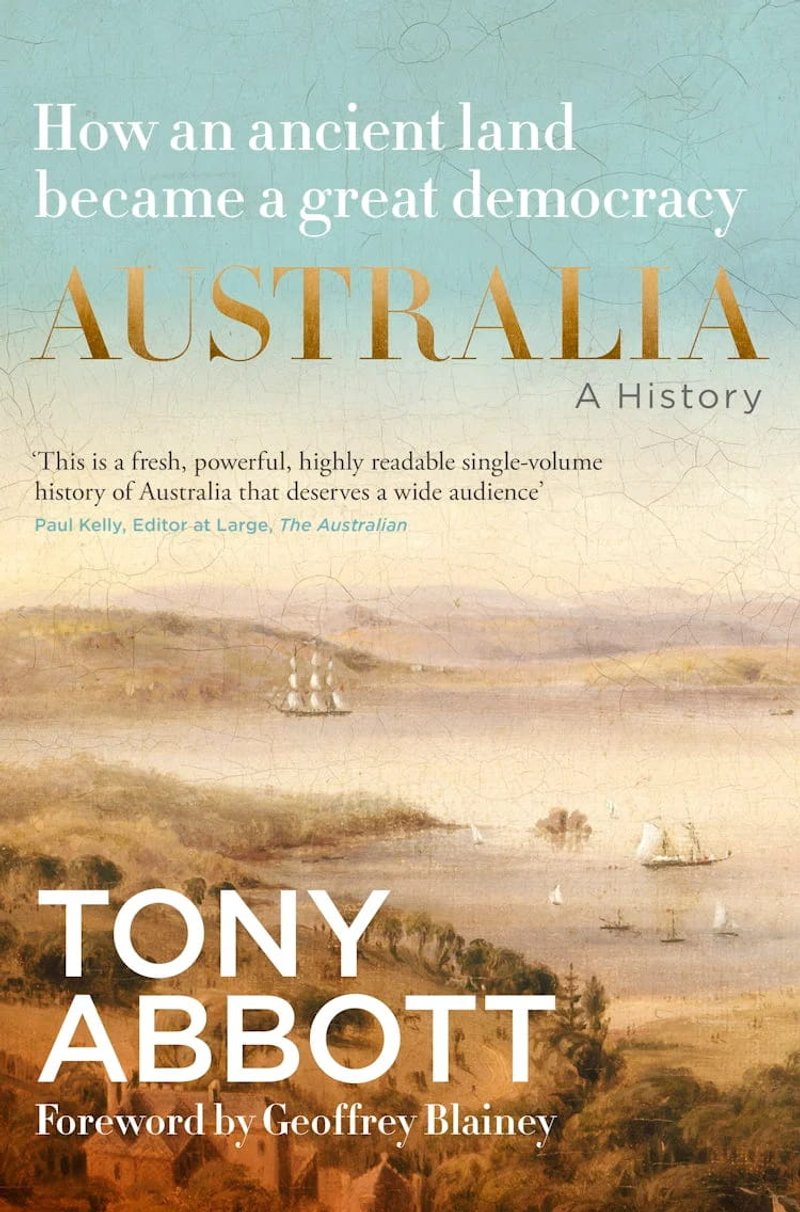
The other day, sauntering into Daunt Books in London, I chanced upon former prime Minister Tony Abbott’s recent single-volume history (Opens in new window) of Australia. The cover jacket was captivating. A good old harbour landscape, light azure skies, and sepia-toned land. Impulsively, I picked it.
A candid confession is due here. Little did I know that the history of the Antipodes would be so revealing. By exploring the past of Terra Australis Incognita, the unknown southern land, one gets a finer sense of the famed island. Where the sun is bright, and everyone has “a fair go”. It was a pleasant revelation. Australia’s past and present are deeply interwoven with the world. As Abbott puts it, the three pegs of modern Australia are “an Indigenous heritage, a British foundation and its immigrant character”.
For an outlander like me, Australian history has much to offer. I suspect it is not different for foreign interlocutors vying to win Canberra’s affection. Mutual trust lies in uncovering our shared stories.
The early part of the book has encounters between Europeans and the Aboriginal ancients. In 1770, after meeting Indigenous Australians for the first time, the British mariner Captain James Cook wrote in his journal, “the Natives of New Holland … may appear … to be the most wretched people on Earth … in reality they are far … happier than we Europeans, being wholly unacquainted … not only with the superfluous but with the necessary conveniences … they live in a tranquillity which is not disturbed by the inequality of condition.”
Of course, reality was not always so neat. Complications would spring soon. For example, when pastoralists and settlers moved into the Tasmanian interior, Indigenous Australians pushed back. Abbott tells that varying degrees of hostility, suspicion, curiosity, and amiability would define the relationship between the Europeans and Aboriginal people for decades to come.
One learns about resolute figures like Arthur Phillip, a Royal Navy officer who served as the first governor of New South Wales. In a quaint turn of events, Phillip had to value his convicts, perhaps even more than his officer brethren. To build a functioning colony, he needed architects, builders, fishermen, doctors, overseers, teachers, and – with enough irony about those in shackles to make Jonathan Swift smile – police. Lachlan Macquarie, the fifth governor of New South Wales and an admirer of William Wilberforce, went a step ahead. He solemnly asseverated, “This country should be made the home and a happy home to every emancipated convict who deserves it.”
By the early 19th century, political debates sprang up. The “exclusives” did not want convicts to mingle in society; the “emancipists” wished convicts a second chance at better lives; and the new free settlers had migrated across the planet in search of gold. Landholders wanted the transportation from Britain to continue while townsfolk in Sydney complained about low wages due to higher convict inflows.
Without giving too much away, the volume proceeds with the story of modern Australia in all its verve and judgement. Political and military history is given its place of pride. From the exploits of General John Monash, whom historian A.J.P. Taylor called the “only general of creative originality produced by the First World War”, to the long tenure of Robert Menzies, up to the modern-day debates between “multiculturalism” and “assimilation”. To be sure, there is another prominent school (Opens in new window) of Australian historiography which centres the Indigenous experience – an aspect that is not the central element of Abbott’s volume.
Despite its geography as a continental island, Australia's history is deeply interconnected with the wider world.
Interesting titbits that illuminated deep Aussie instincts stuck with me. For instance, after the gold rush of the 1850s, the flattening of social hierarchy was rather complete. As Abbott explains, “A British lord on the goldfields had no title but mate”. Australians passionately believed that theirs was the new world. Each person by the dint of their work, by the purpose of their conviction.
Two other factoids that made me chuckle were about the Australia of the sunny 1920s. After the trauma of the First World War, repressed economic demand returned with a bang. Such were the good days that in 1923, the first jars of Vegemite made their debut on Australian grocery shelves. The rest, they say, is legend. Jump five years to 1928, when a precocious Don Bradman made his cricket Test debut. Things could not get better.
To better grasp the Antipodes today, history is the place to begin. There is a dire need today – and this cannot be said enough – for societies in Asia to understand the broader region in which their countries operate. In India’s case, expectations from its partners like Australia make this need crucial. Despite its geography as a continental island, Australia’s history is deeply interconnected with the wider world. From its foundations in imperial Britannia, the existential travails of the World Wars, to the recent schism with the spectre of communism, Australia’s destiny lies in the larger Indian Ocean, best understood with a jog back in time.
Tony Abbott’s Australia: A History is published by HarperCollins (2026).
Ved Shinde is an incoming doctoral candidate at the University of Cambridge. He has previously been associated the Asia Society Policy Institute and the American Enterprise Institute.