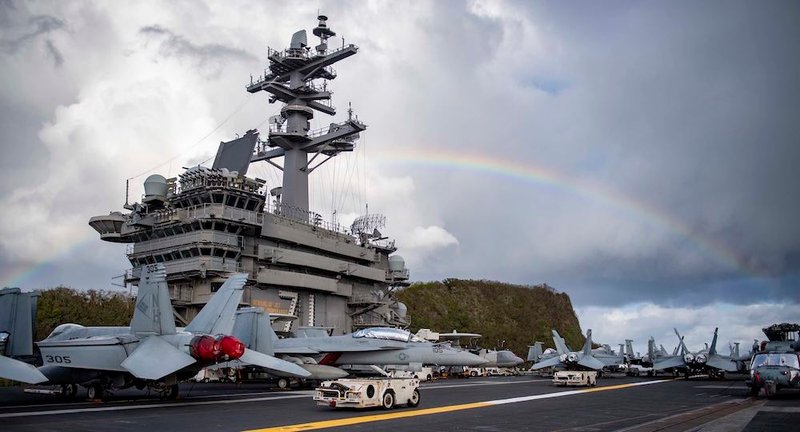
Naval exercises are being heavily affected by the Covid-19 pandemic. The Indian military is postponing all joint exercises it was scheduled to hold with foreign militaries this year because of the crisis. The Indian Navy had previously cancelled this year’s Exercise MILAN, which had been scheduled for late March and would have brought together ships and representatives from most regional navies with the notable exceptions of its potential adversaries, China, and Pakistan.
Similarly, Australia has cancelled its biggest Army exercise for the year, the biennial Exercise Hamel, and will not send troops to this year’s US Indo Pacific Command’s flagship biennial Rim of the Pacific (RIMPAC) exercise. In any case it’s increasingly likely that this large exercise, which was scheduled to bring together 25 regional nations and 25,000 personnel in July, will not proceed.
Naval exercises are an integral part of any navy’s annual program but the benefits are easily overstated, particularly in the case of large scale international exercises such as MILAN and RIMPAC. These exercises are also non-essential in the sense that any diplomatic fall-out as a result of their cancellation is unlikely – all potential participants have a common interest in their cancellation.
The main benefits of exercises, such as MILAN and RIMPAC, are largely rhetorical, lying in their contribution to maritime confidence-building and cooperation in basic naval activities, such as underway replenishment, other fundamental seamanship exercises, and officer-of-the watch manoeuvres, rather than in any purposeful advanced tactical operations. Security restrictions prevent these operations being carried out in exercises other than those between closely allied navies, such as the Royal Australian Navy and US Navy.
Arguably there are only a limited number of essential naval operations that should now proceed in the face of the Covid-19 pandemic. These might include operational requirements, such as support for border protection or those currently underway in the Middle East, and vital exercises, mainly at a national level, to maintain operational readiness. But ultimately there must be trade-offs between operational readiness and the risks of sickness and death among ships’ crews, and between essential and non-essential activities. As the sacked Captain of the Theodore Roosevelt observed, “We are not at war. Sailors do not need to die.”
Sam Bateman