The non-alignment style of diplomacy adopted by the Pacific Islands has proven to be a pragmatic approach to securing their interests. Dealing with all partners – be it China or the United States – has delivered tangible benefits. However, the approach has heightened the anxieties of Australia and New Zealand over regional security.
Australia’s $190 million security assistance package to Solomon Islands announced last year was as much about staving off China in the Pacific neighbour as it was about local security capabilities. In a similar vein, Papua New Guinea and Nauru have also benefited from Australia’s attention. PNG elevated its bilateral security arrangement with Australia to include a defence treaty while Nauru gained a financing deal for its critical infrastructure and finance sector.
New Zealand may not have the same sized purse as Australia, but it is experimenting with expanding its influence through visa waiver arrangements for Pacific Island Forum member states.
But as much as New Zealand and Australia might appear to be working together to secure the region, their individual approaches are also very different. Diplomatic standoffs between New Zealand and some of the small island states are illustrative.
Recent tensions with Kiribati stem from frustration over a perceived lack of care for New Zealand’s aid, while also reflecting New Zealand’s concern about Kiribati’s engagement with China. Similarly, Cook Islands’ moves with China to establish the Comprehensive Strategic Partnership has spilled into a public spat that does not seem to have an end in sight.
A case could be made on the role of the Pacific Island Forum being a mediating body for disputes – particularly those involving Australia and New Zealand.
New Zealand’s Foreign Minister Winston Peters has instigatedreviews of the bilateral assistance packages to both Pacific Island countries. These may only be procedural matters, but the review’s timing and the publicity given implies that choosing partners would have repercussions.
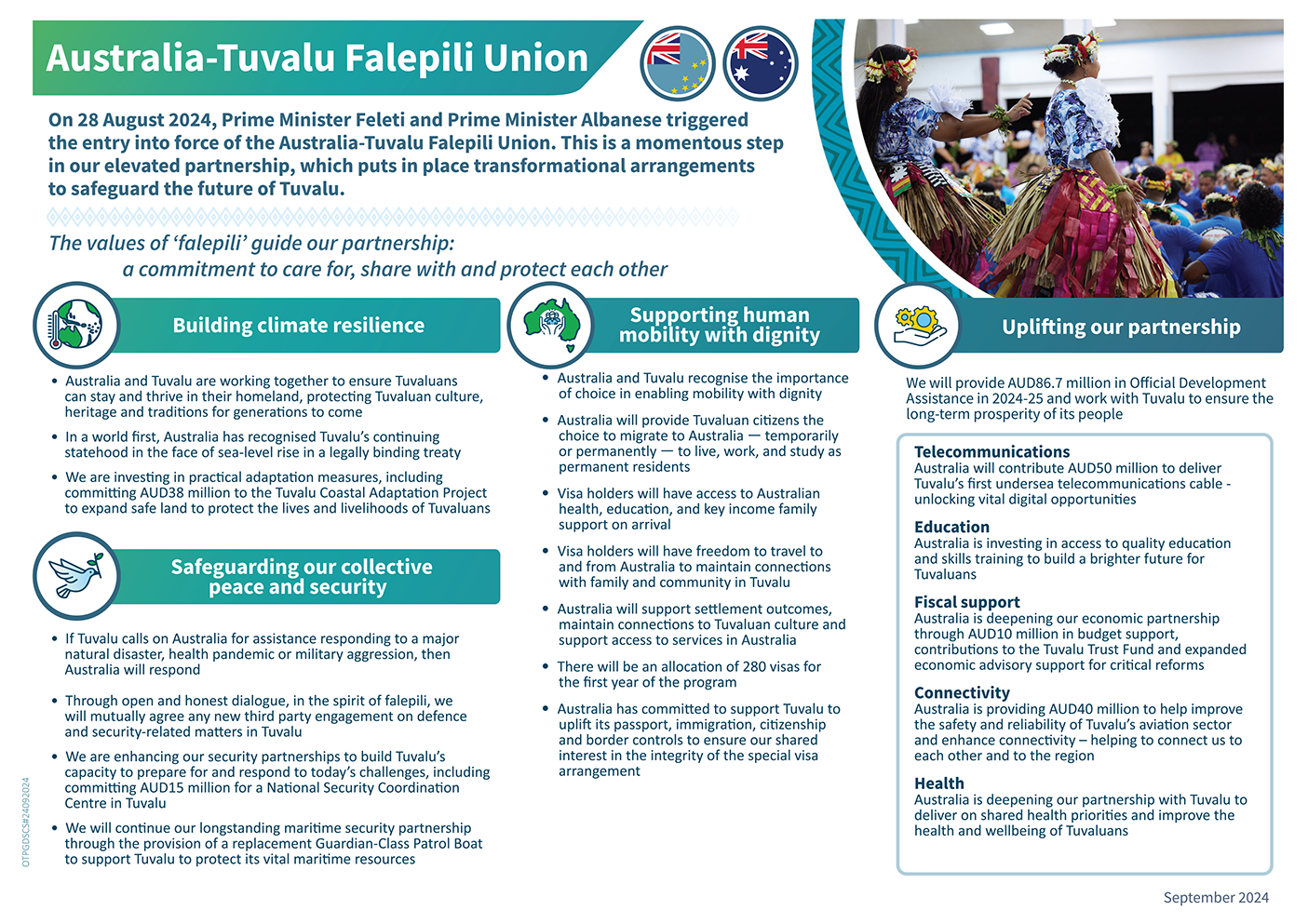
In contrast, Australia’s agreements have expanded its reach in the region. The Falepili Agreement with Tuvalu, for example, creates migration pathways into Australia, meaning that the two countries will be intertwined as Tuvalu works through the impacts of climate change. Likewise, the agreement with Nauru adds to Australia’s growing regional stature, focused on deeper institutional relationships.
Australia’s reach is allowing it to deepen its level of cooperation within acceptable limits. A specific format is emerging, reflected in the Australian Federal Police working with the Royal PNG Constabulary under the Pacific Policing Partnership program. It looks to be a distinct evolution from a sector-wide engagement strategy that typically characterises official development assistance programs.
The level of access is not without its concerns. Sovereignty sensitivities will be a charged issue to navigate, particularly for a region that anchors its diplomacy to non-alignment. It would be unsettling for the broader region watching on should Australia be seen to secure its interests with “veto rights” over other bilateral arrangements. Tuvalu and Nauru may prove to be exceptions in the region.
The stand-off between Cook Islands and New Zealand will also be closely followed, seen as a test of the genuineness of regional unity, particularly from the larger members. Australia and New Zealand have already signaled their willingness to work with the region at a deeper level. It paves the way beyond bilateral deal making toward regionally significant arrangements.
The best opportunity arises from existing institutions like the Pacific Island Forum with the Blue Pacific Strategy. A case could be made on the role of the Pacific Island Forum being a mediating body for disputes – particularly those involving Australia and New Zealand. For all its limitations, it might still serve an important purpose if the desire is for greater regional ties between Australia, New Zealand and the small island states.
The summit next month in Solomon Islands is a good venue to explore this approach. It has the potential to signal the strength of the Pacific Islands Forum as a regional body. For the two largest member states, the forum presents one of the few opportunities to engage with all the smaller island states without other influences.
Regardless, the region seems inevitably driven towards the next phase of engagement. Figuring out how the region navigates towards that future will be important. PNG Prime Minister James Marape captured these sentiments well in his address to the Australian parliament, saying that as neighbours, “we are going nowhere … we have no choice but to get along”.