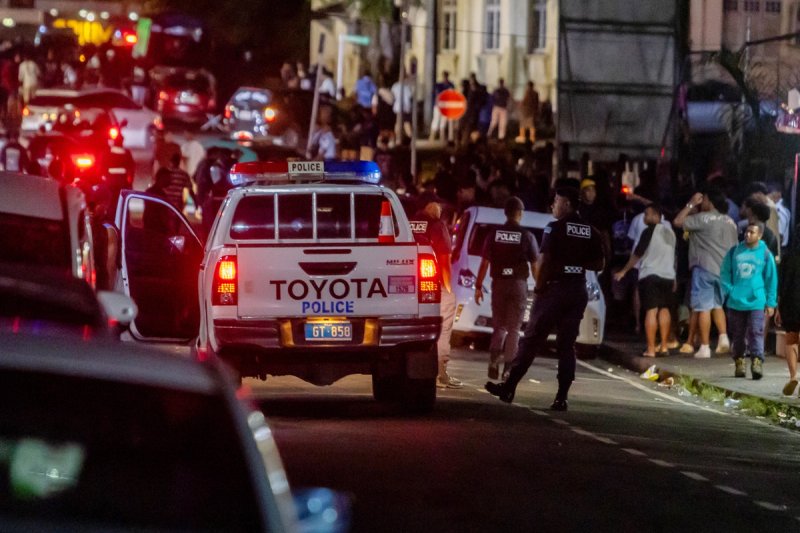
A police patrol car provided with aid from the Chinese government in Honiara, Solomon Islands (Saeed Khan/AFP via Getty Images)
How Pacific Islands are right-sizing Chinese policing
Pacific agency is making a security presence harder for Beijing to sustain.
Newsletters
Subscribe to The Informer for monthly expert analysis, and to Events for advance notice of visiting world leaders and distinguished guests.
You may unsubscribe from Lowy Institute newsletters at any time. For information on our privacy practices and how to unsubscribe, see our Privacy Policy.
|How Pacific Islands are right-sizing Chinese policing
How Pacific Islands are right-sizing Chinese policing
Four years after the Chinese police first arrived in Honiara, Solomon Islands is taking a second look (Opens in new window). In June 2026, new Prime Minister Matthew Wale announced a review of the 2022 security agreement with Beijing, the deal behind the most developed Chinese police presence in the region. Solomon Islands is not alone in reconsidering its arrangement with Beijing. Across the Pacific, a pattern is emerging: governments are deepening economic ties with China while quietly scaling back its police presence on the ground.
Beijing ultimately wants influence to gain access and strategic space from its police deployments. But influence runs both ways and Pacific governments have become adept at hedging (Opens in new window) to achieve their own interests.
Where Chinese policing in the Pacific is heading depends on what Pacific Island governments want from these arrangements, and what they have learned from them so far.
Influence runs both ways and Pacific governments have become adept at hedging to achieve their own interests.
Since 2022, police have been the leading edge of Beijing’s security statecraft in the region. Officers from China’s Ministry of Public Security (MPS) have embedded as trainers and advisers in local forces, marking the security phase of China’s presence (Opens in new window) under the Belt and Road Initiative (BRI). The Chinese Minister for Public Security recently claimed (Opens in new window) that China has deployed 22 police teams to the Pacific, trained 650 Pacific officers in China and donated 38 batches of police equipment. Policing suits Beijing’s purposes. It is easier to justify in countries without standing armies, less geopolitically conspicuous than a military presence, and arguably more effective at advancing China’s security objectives (Opens in new window) in a period of strategic competition.
For their part, Pacific Island governments have sought or accepted Chinese police assistance for a simple reason: they need the resources. Their national security strategies (Opens in new window) consistently call for more equipment and training to meet a widening range of threats. Pacific police forces have developed from varied traditional approaches to governance (Opens in new window), overlayed with Western constabulary techniques – and are expected to impose order across remote archipelagic and mountainous jurisdictions with limited resources and localised challenges to their legitimacy.
It is no surprise they welcome help, or that many favour locally grounded “community policing”. Chinese assistance through training and equipment has been widespread in the Pacific Islands for most of this century (Opens in new window). What changed with the BRI was the shift to a permanent Chinese police presence on the ground. And the same national interest that drew Pacific governments in has led several to recalibrate (Opens in new window) as they learn what works for their own security needs, democratic processes and domestic politics.
Growing awareness of the risks to good governance and the rule of law is driving a developing trend: Pacific Island countries are expanding their economic relationship with China while right-sizing its security role. In practice, that means continuing to accept MPS training and equipment as part of the broader relationship, but reducing – where possible – the presence of Chinese officers embedded on the ground.
Pacific Island governments are choosing deliberately to meet their specific security needs on their own terms. For Australia and other traditional partners, the best response is to be the partner whose policing model fits Pacific systems and needs, while respecting Pacific Island national interests.
Dr Pete Connolly, DSC, CSC is a Non-Resident Senior Fellow and author of a forthcoming publication on Chinese policing practices in the Pacific at the United States Studies Centre.