United States, explained.

Saul Loeb/AFP via Getty Images
Trump didn’t cause America’s retreat from Asia – he’s the symptom
A multipolar world matters more than one man’s antipathy to alliances.
United States, explained.
Saul Loeb/AFP via Getty Images
A multipolar world matters more than one man’s antipathy to alliances.

Subscribe to The Informer for monthly expert analysis, and to Events for advance notice of visiting world leaders and distinguished guests.
You may unsubscribe from Lowy Institute newsletters at any time. For information on our privacy practices and how to unsubscribe, see our Privacy Policy.
Trump didn’t cause America’s retreat from Asia – he’s the symptomTrump didn’t cause America’s retreat from Asia – he’s the symptom
Last week Donald Trump gave America’s Asian allies yet another reason to wonder about the future of America’s role in the region. By nonchalantly slashing a key annual exercise with South Korea he made it clearer than ever how little he cares about the strategic interests and perceptions of countries that America is supposedly committed to defend.
Foreign Minister Penny Wong coyly alluded to this in her Allan Gyngell Lecture (Opens in new window) to the Lowy Institute this month. In a characteristic understatement, Wong said, “We have always understood that President Trump envisages a different role for the United States in the world.”
What she said next is important. “Even so,” she said, “the United States remains the world’s largest economic and military power, with daily influence over international events that have consequences for every nation, including Australia.”
Her message is clear. Donald Trump is an aberration, and when he passes from the scene things will return to the way they used to be, with America as committed and as capable as ever of ensuring Asia’s stability and Australia’s security.
That is a big mistake, because it both underestimates and overestimates Trump. It underestimates what he means for US domestic politics. And it overestimates what he means for America’s changing role in the world and in Asia.
Trump has not dominated and transformed American politics through his own strange and remarkable capacities. He has been enabled by deep flaws in the US political system, especially in the two great parties at its core.
The old Republican Party has collapsed under Trump’s assault, and now stands for whatever Trump says it stands for. In 2028, even if Trump does not find a way to run himself, he will in effect decide the party’s candidate, and JD Vance is considered the favourite (Opens in new window).
There is much more to America’s flight from global leadership, including in Asia, than Donald Trump.
Meanwhile the Democratic Party has utterly failed to mount an effective response to Trump. It has been unable to construct a credible centrist policy agenda with broad appeal, and has found no compelling figures to lead it. The mid-terms remain a toss-up, and the tepid Kamala Harris is the party’s current front-runner (Opens in new window) for 2028.
So don’t expect a post-Trump era anytime soon. And when it comes, the question for US allies like Australia will be whether there is any support, on either side of the aisle, for the old bipartisan commitment to US global leadership on which those allies have depended for so long. Will Republicans return to the policies of John McCain, or the Democrats to those of Hillary Clinton?
There are very compelling reasons to think that they will not, because there is much more to America’s flight from global leadership, including in Asia, than Donald Trump. It goes to a fundamental shift in the balance between imperatives that have impelled America to exercise global strategic leadership, and the costs and risks of doing so.

Exercise Pacific Dragon 2026 (Tony Wright/DVIDS)
America today has nothing like the powerful imperative that drove it to shoulder Cold War-era burdens from the 1940s to the 1980s. That is because in today’s multipolar world there are not just two great powers but several, and none of them has any real chance of asserting the kind of global hegemony that the Soviet Union might have achieved had it not been contained by America.
Instead, we have a multipolar system more like the 19th century global order than anything we saw in the 20th century. That means America today has much less to fear from events in Europe and Asia than it had in the 20th century, and much less reason to keep bearing the burdens that it used to accept.
And this explains what has really been happening to America’s global strategic posture over the past 15 years. The Washington foreign policy establishment – the kind of people who populated the Biden administration – have continued to talk up their commitment to sustained US global leadership. But America has done nothing to rebuild the strength it would need to meet and defeat the challenges from Russia and China.
This is clear in Europe, where America has found no effective response to Russia’s aggression against Ukraine. It is even clearer in Asia, where despite President Barack Obama’s “Pivot to Asia” and President Biden’s talk of “extreme competition”, Washington has sat on its hands while China’s extraordinary buildup of air and naval forces has robbed America of its once overwhelming military advantage.
America has not risen to these challenges because it does not have to. Why should America today risk nuclear war to defend South Korea from the North, or Taiwan from China? In a multipolar world China might come to dominate East Asia and the Western Pacific but it will not threaten America because it cannot dominate Eurasia.
Nor will Russia threaten America even if it re-dominates its old empire, because it can and will be contained by Europe and China. With or without Trump, we are back in a balance-of-power world in which America does not need to worry much about what happens outside its own hemisphere.
The difference is that Trump does not pretend otherwise. For that we should, in an odd way, be grateful to him. His antics help us to see that the old era of US global leadership is over, and with it the prospect of a strong America strategic role in East Asia and the Western Pacific. That has seismic implications for Australia, which we continue to ignore.
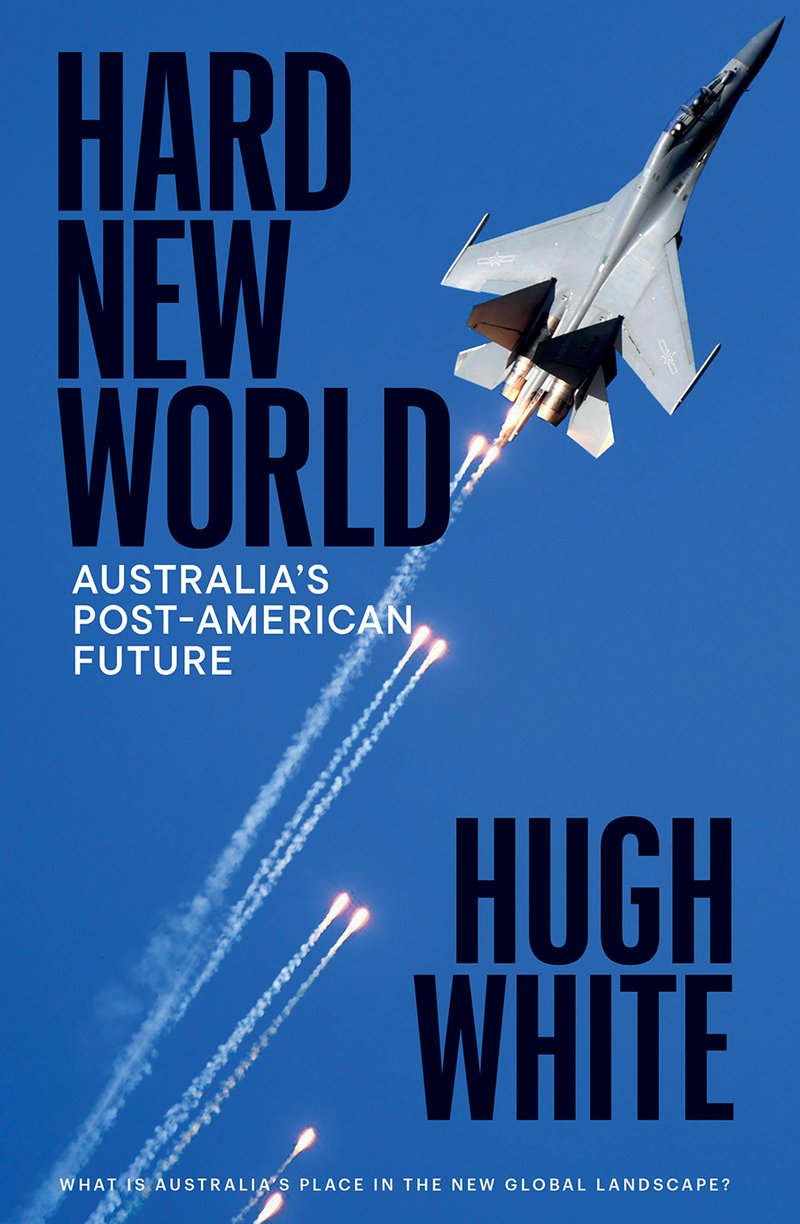
Hugh White’s new book Hard New World: Australia’s Post-American Future (Opens in new window) is published by Black Inc.
About the author
Hugh White
Professor Hugh White AO FASSA is Emeritus Professor of Strategic Studies at the Australian National University in Canberra.
The most-pressing world events explained by Lowy Institute experts and global contributors, in your inbox, every Thursday.
You may unsubscribe from The Interpreter at any time. For information on our privacy practices and how to unsubscribe, see our Privacy Policy.