Published daily by the Lowy Institute

Åland, and the fate of demilitarised islands on Russia’s doorstep

Deliberately defenceless, this Finnish territory at the heart of the Baltic Sea is still threatened.

A dedicated group of Ålanders has held a protest at 5 o’clock in the afternoon each day outside the Russian consulate following the full-scale invasion of Ukraine (Alessandro Rampazzo/AFP via Getty Images)

The Finns are nothing if not prepared. Through their doctrine of “comprehensive security”, they have built a whole-of-society approach to protecting their country. This involves each element of the state, as well as the private sector and individual citizens having a role to play to maintain the vital functions of society in any potential crisis. Vigilance is incorporated into everything the Finns do, and, of course, this also includes a military capability that far exceeds what would be expected of a country of just 5.5 million people.

Despite this, one piece of Finnish territory remains conspicuously unguarded.

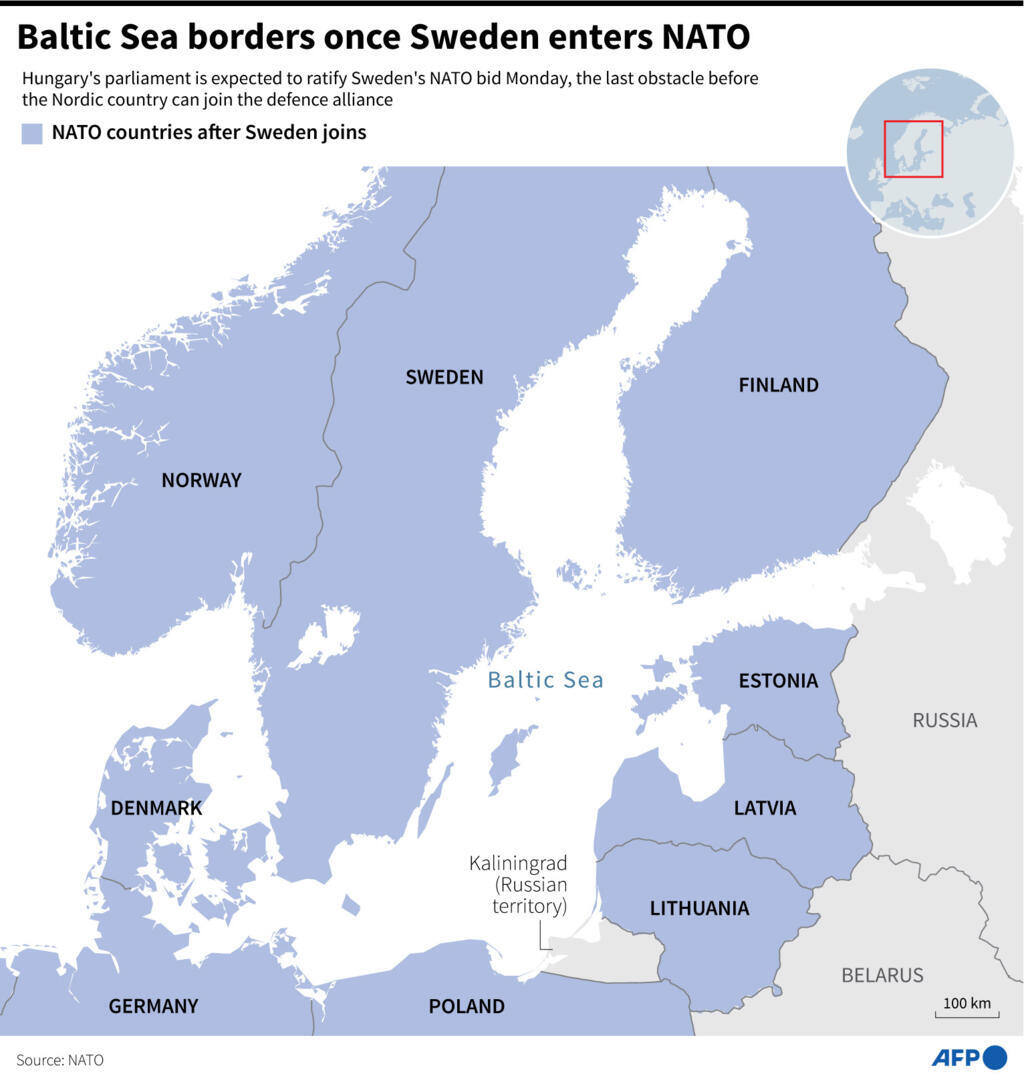
Lying at the mouth of the Gulf of Bothnia, and overseeing both the Baltic Sea and the Gulf of Finland are the Åland Islands – an autonomous, Swedish-speaking, region of Finland of around 30,000 people. Their location would enable considerable naval and air control of the chokepoints in the northern Baltic Sea, yet by law no military equipment is allowed to enter. This is because the islands are subject to a series of longstanding international agreements borne from Europe’s warring past.

In 1808, the Swedish and Russian empires went to war over the then-Swedish territory of Finland. A Russian victory saw the creation of the Grand Duchy of Finland, an autonomous state within the Russian Empire. Sweden’s position was weak enough that it was unable to maintain sovereignty of Åland, despite the islands being “the fore-posts of Stockholm” as Napoleon described them.

The Russians, understanding the importance of their location, built a number of fortifications on the islands. Yet in the mid-19th Century, as the Crimean War distracted Russia in the Black Sea, the British and French saw an opportunity to hinder Russian capability in the Baltic Sea by capturing these military installations on Åland. The Treaty of Paris which concluded the Crimean War handed Åland back to the Russians, but on the condition that the islands become demilitarised.

FrankRamspott/DigitalVision Vectors/Getty Images

Upon Finland’s independence in 1917, the islands expressed a desire to become part of Sweden. The dispute was taken to the League of Nations who ruled in 1921 that Finland would maintain sovereignty of the islands but must guarantee the population their Swedish language, culture and system of self-government. This included the maintenance of the demilitarised status stipulated by the Treaty of Paris. In addition, the islands were to remain neutral. Meaning that even if Finland is at war, Åland isn’t. As part of this arrangement, Ålanders are exempt from Finland’s military conscription for all male citizens.

Yet one of the on-going paradoxes of Åland’s status is that under its League of Nations mandate, Finland has the obligation to protect the demilitarised and neutral status of Åland, but – during a time of war – can only do so by militarising the islands themselves. During the Second World War, Finland – having made a devil’s bargain that Nazi Germany posed it less of a threat – militarised the islands for three years in order to prevent a Soviet invasion, although the Finns did not use the islands for any offensive manoeuvres.

Ålanders also see their autonomy and their unique status as an example that can be utilised in other complex states where there is a geographically concentrated distinct minority.

The threat of Soviet invasion came because of an agreement signed between Finland and the Soviet Union following the Winter War in 1940. The agreement confirmed the respect for the demilitarised status of Åland, but the Soviets did not agree to their neutralisation. Which, given the expansionism of the Soviet Union, and complete disintegration of Europe’s rules at the time, led Helsinki to believe – with legitimacy – that Åland may be under threat.

This suspicion about Russia’s intentions remains to this day. Åland’s current premier, Katrin Sjögren, confirmed to me that “Russia has never accepted Åland’s neutralisation.” How Russia views Åland is distinct from how other states in the region view the islands.

From Moscow’s perspective, Finland’s sovereignty of the islands means that demilitarisation serves its current navigational interests in the Baltic Sea. With Russia only controlling 7% of the Baltic Sea littoral, having less militarised posts makes the Kremlin feel less constrained. But given the strategic importance of the islands, accepting neutralisation would tie Moscow’s hands should there be a change in conditions in the region.

Although Russia’s attempt to change conditions in Europe through its invasion of Ukraine has probably made Åland more secure, with both Finland and Sweden joining NATO in response – turning the Baltic into a “NATO lake”. Yet this shift in Finnish defence policy away from its own neutrality has also created new questions about Åland’s unique status.

While Finland has the right to defend the islands should they come under threat, Sjögren told me that it remains unclear whether this defence would only include Finnish forces, or now, NATO forces could be deployed. Sweden – another new NATO member – would also find any threat to Åland unacceptable to its own security. As would other NATO member states reliant on Baltic Sea shipping lanes.

Finland's autonomous Aland Islands are a picturesque archipelago once part of Russia and whose demilitarisation dates back more than 160 years. (Photo by Alessandro RAMPAZZO / AFP
Finland’s autonomous Åland Islands are a picturesque archipelago once part of Russia and whose demilitarisation dates back more than 160 years (Alessandro Rampazzo/AFP via Getty Images)

Given the major shift in Finnish defence policy, Russian propagandists have been warning that any change to Åland’s status from Helsinki may be a trigger for war. Rather than a genuine threat, the purpose of such commentary is to spread misinformation in the hope of sowing division within Finnish society. However, as part of its “comprehensive security”, Finland’s education system is noted for providing its citizens the capabilities to navigate such noise. It means these tactics gain little traction.

Instead, the wholesale distrust of Russia within Finland has led to the public questioning a curious provision within the 1940 Finland-Soviet agreement. The agreement afforded Russia a consulate on Åland which is allowed to “monitor” Finland’s commitment to the islands’ demilitarisation. A function outside of the usual scope of a foreign consulate, and one that could be interpreted broadly to include a range of espionage operations.

In 2023, the Finnish Prime Minister, Petteri Orpo, referred to this provision as an “historical relic”, and launched an inquiry into the consulate’s status. For the Finns it seems absurd that Russia has the right to monitor compliance with an international agreement when it is in such flagrant violation of international law in Ukraine. Yet the inquiry concluded that it was not clear whether this article in the agreement could be separated from the agreement in total – meaning Finland may be in breach of the entire agreement if it tried to close the consulate. Therefore, the Finnish government has decided not to proceed.

What the Russian consulate is mostly monitoring at present is the anger of Ålanders at Moscow’s aggression. Each day since Russia’s full scale invasion of Ukraine, a dedicated group has held a protest at 5 o’clock in the afternoon outside the consulate. The park opposite the building has been renamed Ukrainaplatsen (Ukraine Place), with its Ukrainian flag facing the consulate’s Russia one, and a peace symbol with sunflowers in full view of the building’s windows. The group chant slogans and sing a pro-peace song in Swedish to the tune of Beethoven’s Symphony No. 9.

The group’s dedication is due to the ideals of demilitarisation and neutrality having become an integral part of Ålanders’ identity. While this status was enforced on the islands from international agreements far outside their control, these agreements have shaped the way Ålanders see the world – with a clear understanding of Russia’s current aggression. Alongside this, Ålanders also see their autonomy and their unique status as an example that can be utilised in other complex states where there is a geographically concentrated distinct minority.

But it is this unique political status that also protects Åland’s cultural status as a Swedish-speaking region. Although Finland itself is an officially bilingual state, and communication between Åland and the Finnish government is mandated to be conducted in Swedish, Sjögren informed me that it is occasionally difficult to find fluent Swedish-speaking contacts within various Finnish ministries. The native Swedish-speaking population of Finland has declined from around 13% at the start of the 20th Century to about 5% today – decreasing the linguistic resources the Finnish state can draw upon.

The social licence for Ålanders to remain part of Finland is built on official bilingualism. Sjögren asserted that were Helsinki to change this policy it would threaten the agreement on Åland’s status as Finnish territory. Therefore, the demilitarisation and neutrality that are central to Åland’s status act as a buffer against incorporation into greater governing control from the Finnish mainland – which could weaken Åland’s hand in protecting its language and culture.

This may not sit comfortably with Finland’s defence planners whose instincts would be to have all Finnish territory be as prepared and vigilant as the mainland. Russia’s actions in Ukraine have heightened conditions in the Baltic Sea, making Åland’s location even more vital. Although in an ideal world, it would be Åland’s political status, rather than its geography, that would be prized.



You may also be interested in