Today, parliament’s Joint Standing Committee on Foreign Affairs, Defence and Trade tabled its report (Opens in new window) on the inquiry into the role of Australia’s international development program in preventing conflict. Its recommendations are a chance to put the system in place that the Foreign Minister’s commitment depends on.
The tensions that tore through Solomon Islands in the early 2000s had been building for years: land disputes, youth unemployment, distrust of weak institutions. Australia’s response, the Regional Assistance Mission to Solomon Islands (RAMSI), cost $2.6 billion (Opens in new window) in its first decade. No one can say if the violence could have been prevented, but the warning signs were visible years earlier.
A resilience lens adds a different question: what is holding societies together, and is it getting stronger or weaker?
Conflict prevention is now an established Australian foreign policy priority. The push has centred on deterrence and diplomacy to manage the biggest geostrategic risks. The role of development cooperation in helping prevent conflict is less clear, as is the relationship of all three tools in an explicit Australian approach (Opens in new window).
The inquiry set out to address this. The first ten recommendations in its report ask the Government to keep doing what works to prevent conflict: steady development funding, support for gender equality and Women, Peace and Security, inclusive development, strong public institutions, and conflict sensitivity. The report also backs something the humanitarian sector has long sought: a standing sanctions exemption for legitimate humanitarian assistance.
Most interestingly, the report sets out the parts of a conflict prevention system: an explicit conflict prevention statement covering conflict within and between states, a central function and a thematic ambassador in DFAT, conflict sensitivity training and resources, conflict prevention indicators and reporting, and stronger early warning that triggers coordinated action. Coalition members’ additional comments (Opens in new window) argue that overall aid levels fall outside the inquiry’s remit, but do not dissent from these recommendations.
The key question for the government’s response to the inquiry is whether it takes up these recommendations as a system or cherry-picks from them.
The risk is a response that picks the easiest recommendations and notes the rest. But a conflict prevention statement will stay on paper unless a central team and an ambassador in DFAT drive it. They will do little more than share information unless early warning shows them where risk is building. And without indicators to track progress and report on it, no one will know whether the statement is being delivered.
Early warning is what lets the other parts act in time. To do that well, it needs to be built to track resilience as well as risk.
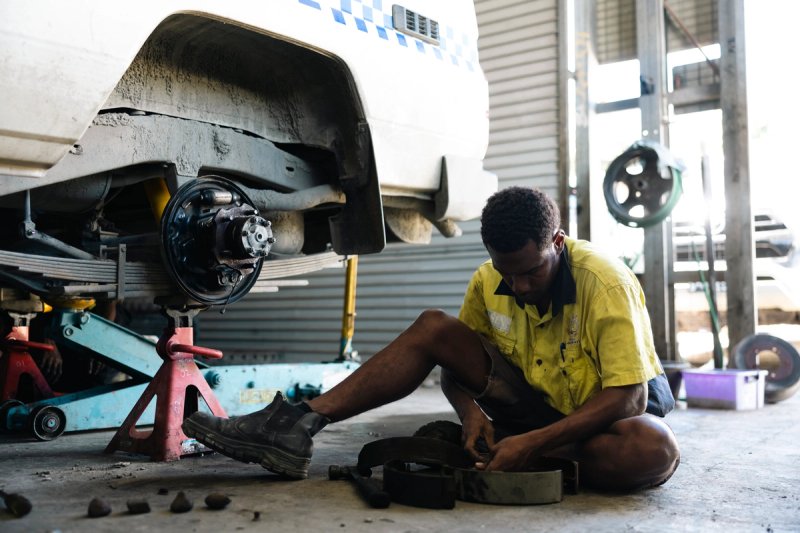
A Royal Solomon Islands Police Force mechanic services a police vehicle at Rove Police Station, Honiara, part of an annual Australian-run training program, 27 March 2026 (Riley Blennerhassett/Department of Defence)
Early warning that monitors only risk often sounds the alarm once protesters are already on the streets and the prevention window has narrowed. A resilience lens adds a different question: what is holding societies together, and is it getting stronger or weaker? Tracking resilience over time alongside risk would give Australia a clearer picture of where tension is building while there is still time to act. DFAT told the inquiry (Opens in new window) it could strengthen its use of early warning and resilience monitoring.
It is also a quick win. It could be piloted with modest funding in a few countries where Australia has deep relationships. Coalition members stress that aid effectiveness depends on “how funding is targeted and used”. Targeting it well needs a shared view of where resilience is shifting and risks are building.
That picture has to cover the full range of conflict risk. The OECD’s latest fragility assessment (Opens in new window) rates six contexts in Southeast Asia and the Pacific as highly or extremely fragile. In the Pacific, local grievances and geostrategic competition feed each other (Opens in new window). The committee rightly asks for the conflict prevention statement and DFAT’s central function to cover conflict within states as well as between them. Early warning needs to watch both, or it will miss half the picture.
In Southeast Asia, the Iran war has pushed up fuel and food prices and is straining budgets. Yet in the Development Intelligence Lab’s latest Pulse Check (Opens in new window), nearly 100 experts across nine countries still named climate change the decade’s most defining disruption, as did respondents to ISEAS’s most recent survey (Opens in new window). The inquiry report calls climate change a threat multiplier of conflict risk. The Southeast Asia Pulse Check experts’ top priority for partners was national resilience systems that can manage compounding shocks. So, a prevention system built around resilience would start from what partners themselves are asking for.
RAMSI in Solomon Islands showed what reacting late costs Australia and its neighbours. The Foreign Minister has made prevention a priority, and parliament has set out what a system could look like to deliver it. The government’s response should treat the recommendations as one system, with early warning that can see resilience weakening while there is still time to act.