Fair attendees see South Korean books at a round table during Bogota's International Book Fair "FILBO" in Bogota, Colombia, 2022 (Chepa Beltran via Getty Images)
Hallyu can open the door – stocking the shelf is harder
Korean literature is riding a cultural wave, but translation grants alone can only take it so far.
Newsletters
Subscribe to The Informer for monthly expert analysis, and to Events for advance notice of visiting world leaders and distinguished guests.
You may unsubscribe from Lowy Institute newsletters at any time. For information on our privacy practices and how to unsubscribe, see our Privacy Policy.
|Hallyu can open the door – stocking the shelf is harder
Hallyu can open the door – stocking the shelf is harder
Korean books build soft power more slowly than K-pop or K-drama. Translation grants by the Korean government are a step in the right direction, but they need to be one of many steps.
I still remember a time when I had to explain Korean dramas to people who had never watched them. I would share recommendations unasked, and hope someone would grow to be as attached to these dramas as I was. Now the same people’s watch list is probably longer than mine.
That is the magic of Hallyu – also known as the Korean Wave. This “wave” refers to the global rise and spread of South Korean popular culture. Think “Gangnam Style”, the band BLACKPINK, the hit film Parasite or global TV phenomenon Squid Game.
Can books join as part of this wave?
A month back I recommended a translated Korean novel to a friend who watches Korean dramas. Her response: “Maybe when I have a long flight.”
A song or a visual can cross the world overnight. A book moves like a letter passed from desk to desk, meandering its way through editors and proofs and second opinions among other things. This is all before it even meets a reader. Korean literature is undoubtedly joining the swell of popularity that is Hallyu. But the harder work of getting them read has just begun.
Sustained institutional partnerships with mainstream international publishers to ensure that when Hallyu opens the door, the books are already waiting on the shelf.
Korea has built the machinery to get books translated. Seoul funds the translation of Korean literature through the Literature Translation Institute of Korea (LTI Korea), which is a public institution under the Ministry of Culture, Sports and Tourism. In written responses to questions, the institute said Han Kang’s 2024 Nobel Prize marked “a turning point for Korean literature on the global stage.” Overseas sales of the titles it has supported rose from 520,000 copies in 2023 to 1.2 million in 2024. It describes its aim as taking readers “beyond a select few well-known authors and works.”
It amounts to a fascinating example of how South Korea, a country of 51.5 million people, continues to drive its cultural frontier outward. Support from state funding for translation helps. But what is also needed is for someone to lean across a table to say, “You have to read this”.
Fans – or the super obsessive type referred to as “stans” blending “stalker” and “fan” – are active in promoting K-pop and K-drama artists and productions. With K-lit, there is potential to intersect, but the dynamics are not the same.
Taylor Bradley of Honford Star, which publishes Korean literature in translation, told me that “there is some overlap”. He pointed to ARMY, the fanbase for K-pop boy band BTS, showing up for books recommended by songwriter Kim Namjoon, widely known as RM. “That said, the K-pop and K-drama audience is much larger, so most of them don’t actually read Korean literature.” It’s a view echoed by Jieun Kiaer, Professor of Korean Linguistics at the University of Oxford, who observed that “[l]iterature works on a longer timescale than popular culture”.
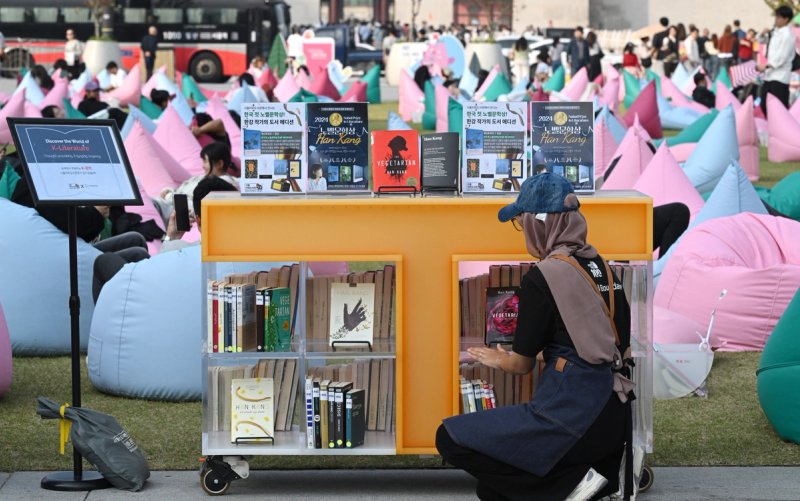
Books on display by South Korean author Han Kang, who won the 2024 Nobel Prize in Literature, displayed during an outdoor library event at Gwanghwamun square in central Seoul in 2024 (Jung Yeon-je/AFP via Getty Images)
When I asked Sanya Bhardwaj, a content writer in New Delhi, how she came to know about Korean culture, she pointed to a K-pop event in Delhi in 2016. The first book about Korea she picked up was a comic from the Korean Cultural Centre, handed to her by a Korean chef. So, the way was paved by multiple sources. But this, to say plainly, is a great deal of luck to ask of every reader.
Even when readers go searching for books, in my experience shops tend to stock only the mega-sellers like The Vegetarian. Everything else is in some unknown corner marked for translated fiction.
Marianna Baroli, who is a journalist specialising in Korean culture, global entertainment and soft power at the Italian news weekly Panorama, says Korean literature is now easy to find in Milan, in major bookshops and online, especially celebrated authors. Emerging voices and experimental fiction have a harder time. “Translation is only part of the challenge,” she says, “discoverability, editorial investment and cultural mediation are equally important.” (Baroli is working on an editorial research project on Korean literature’s international reception, From Page to Culture, which is supported by LTI Korea.)
Unlocking that broader potential will require sustained institutional partnerships with mainstream international publishers. That will help ensure that when Hallyu opens the door, the books are already waiting on the shelf. Until then, not to take any credit, but readers like me will keep recommending books unasked, hoping to make people read the same way we once made them watch dramas.