China's President Xi Jinping shakes hands with Papua New Guinea's Prime Minister James Marape before leaders take a group photo during the Asia-Pacific Economic Cooperation (APEC) on 19 November 2026 in Shenzhen, China (Getty Images)
Marape reassures Beijing after PNG’s pacts with the West
Infrastructure, roads and gas money explain why Port Moresby will play both sides in the China–US rivalry.
Newsletters
Subscribe to The Informer for monthly expert analysis, and to Events for advance notice of visiting world leaders and distinguished guests.
You may unsubscribe from Lowy Institute newsletters at any time. For information on our privacy practices and how to unsubscribe, see our Privacy Policy.
|Marape reassures Beijing after PNG’s pacts with the West
Marape reassures Beijing after PNG’s pacts with the West
PNG Prime Minister James Marape spoke to (Opens in new window) Xi Jinping in Shenzhen ahead of the APEC Summit last week, telling China’s President that the decision to close Taiwan’s representative office in Port Moresby had been politically difficult and expressed “hope this assists you in your efforts for reunification”.
Marape’s remarks stand out for two reasons. First, Marape appears to have gone further than previous PNG prime ministers by explicitly supporting reunification. Second, his statement may reflect an effort to reassure Beijing following PNG’s recent security agreements with Australia and the United States.
More broadly, the episode illustrates the difficulties PNG faces in maintaining an independent foreign policy while engaging with competing powers.
Going beyond the One China policy
PNG recognised Beijing in 1976, apart from a brief switch to Taiwan in 1999 – but recognising Beijing’s government is different from explicitly backing reunification. Successive PNG governments have generally avoided taking direct positions on how the dispute should be resolved. Marape may be the first PNG prime minister to publicly endorse reunification in such direct terms.
So why take this position now?
For Canberra and Washington, the lesson is that security agreements do not guarantee broader foreign policy alignment.
But closing Taiwan’s office also carries economic costs. Taiwan announced that it would stop purchasing PNG’s liquefied natural gas (LNG). Last year, Taiwan had imported 1.8 million tonnes (Opens in new window) of PNG LNG worth about (Opens in new window) $800 million.
For Beijing, Taiwan is a core political issue, giving Marape’s statement considerable diplomatic weight. Xi acknowledged PNG’s position, praising Marape for having “firmly adhered to the ‘one China’ principle”.
The challenges from within
Marape’s admission that closing Taiwan’s office was politically difficult was equally interesting. He told Xi: “I faced challenges from within, because we also relate to many nations, but we were resolved.” Public opinion was probably not the main obstacle: foreign policy rarely features (Opens in new window) in PNG’s domestic debates, which are dominated by employment, inflation, public services and law and order, while China and Taiwan remain the preserve of a small urban, political and academic elite.
Marape may instead have been referring to resistance within government, the bureaucracy or PNG’s security establishment – or indirectly acknowledging concerns from the United States. The US State Department described Taiwan’s office closure as “yet another example of Beijing’s intimidation campaign against Taiwan”. Although there is no direct evidence Canberra opposed the move, Marape would have been aware of its concerns. His reference to PNG’s relationships with “many nations” may have been deliberately ambiguous, allowing him to demonstrate political commitment to Beijing without identifying those who may have opposed the decision.
Reassuring Beijing after PNG’s security agreements
Marape’s remarks may also be read against PNG’s expanding security ties (Opens in new window) with Australia and the United States – the 2023 Defence Cooperation Agreement with Washington and the 2025 Pukpuk Treaty with Canberra – which may have left Beijing fearing PNG was drifting into the Western security architecture.
Marape’s explicit support for reunification challenges that perception, reassuring Beijing that PNG remains committed to the bilateral relationship despite its growing security cooperation with Western partners, and that defence agreements do not determine its diplomatic positions on other issues. Marape reinforced this message by invoking sovereignty:
“China respects the sovereignty of Papua New Guinea. We must give full respect for the sovereignty of China.”
Although directed at Beijing, he may have had a secondary audience. If Australia and the United States assume PNG is already firmly within their sphere of influence, they may have less incentive to compete for its cooperation. Maintaining constructive relations with Beijing gives PNG additional diplomatic and economic options.
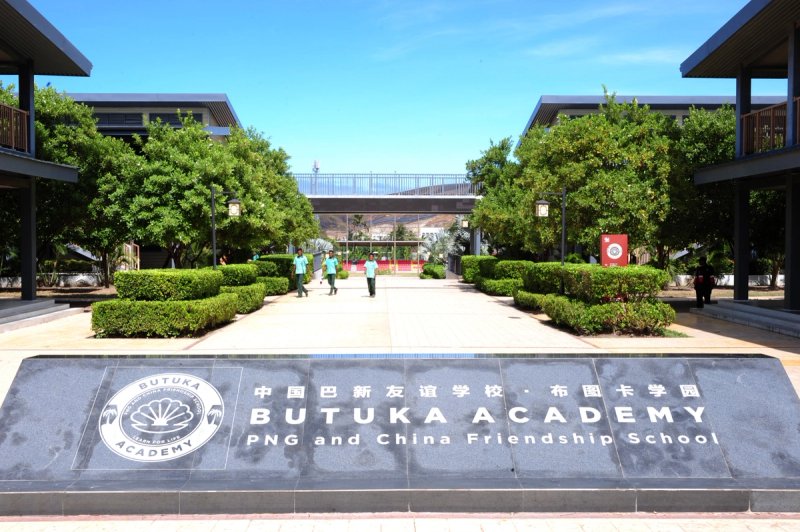
The Butuka Academy in Port Moresby, Papua New Guinea, funded by China and opened in November 2018 to accommodate students in its kindergarten, primary school and secondary school (Zhang Jianhua/Xinhua via Getty Images)
Why PNG cannot walk away from China
China remains an economic partner PNG cannot easily abandon – and neither Australia’s development aid (Opens in new window) nor the United States’ expanded security role gives either country real leverage to change that.
China provides infrastructure financing, investment, construction services and access to markets. In fact, Chinese state-owned enterprises dominate (Opens in new window) the infrastructure sector, implementing projects financed by multilateral institutions, including the Asian Development Bank. Chinese economic involvement consequently extends beyond projects directly financed by Beijing.
Roads, bridges and other visible projects are especially important in PNG politics, to allow politicians to demonstrate that they are delivering to their constituencies. The Connect PNG (Opens in new window)road program is illustrative of the relationship between infrastructure development and political popularity. This road network is intended to connect 13 economic corridors and provinces not previously linked by roads. Marape this year led a convoy of 100 vehicles (Opens in new window) over 830 kilometres from Port Moresby to Morobe Province – on what is now named Pangu Highway, after his own party, and built largely by Chinese contractors.
Chinese financing may also appeal to PNG leaders because it is often perceived as involving fewer political and governance conditions than traditional Western assistance, although loans still carry repayment obligations and financial risks. For leaders facing enormous development challenges and limited fiscal resources, these opportunities are difficult to ignore.
PNG’s longstanding foreign policy of “friends to all, enemies to none (Opens in new window)” provides the flexibility to maintain relationships with competing powers. Although Marape has introduced different versions of this approach, his recent actions suggest that the underlying principle remains. For Canberra and Washington, the lesson is that security agreements do not guarantee broader foreign policy alignment. For PNG, the challenge is whether it can continue balancing these relationships as strategic competition intensifies.