A polling station in Auckland, New Zealand, 7 November 2026, with an outcome that's too close to call (Brendon O'Hagan/Bloomberg via Getty Images)
New Zealand’s foreign policy could change – but we won’t know for weeks
And the election limbo will cost New Zealand a voice at APEC and COP.
Newsletters
Subscribe to The Informer for monthly expert analysis, and to Events for advance notice of visiting world leaders and distinguished guests.
You may unsubscribe from Lowy Institute newsletters at any time. For information on our privacy practices and how to unsubscribe, see our Privacy Policy.
|New Zealand’s foreign policy could change – but we won’t know for weeks
New Zealand’s foreign policy could change – but we won’t know for weeks
New Zealand has now entered an unknown number of weeks of political limbo following a general election on Saturday, which left neither bloc able to declare victory. Now, we wait (Opens in new window) until 27 November, the deadline for tallying the 400,000 special votes (Opens in new window), and then perhaps another week while recounts happen.
Then the coalition negotiations can really begin.
As it stands, the National-led centre-right bloc, supported by Winston Peters’ populist New Zealand First and the libertarian ACT, just have enough to govern (Opens in new window). But they could easily lose a seat or two as special votes, which tend to favour the left, come in.
The Labour Party, supported by the Greens and Te Pāti Māori, would need the support of newcomer Opportunity (Opens in new window), a centrist party that’s strong on climate and shares much in common with Australia’s Teals. Their road to majority is convoluted but not impossible.
The outcome could considerably change the tone, if not the overall trajectory, of New Zealand’s foreign policy. The outcome could significantly change the tone, if not the overall trajectory, of New Zealand’s foreign policy. While the country will still continue to rely on China economically and count on the US-led security infrastructure in the Pacific, the way Wellington communicates with and about these two giants could take on a markedly different tone.
This is exactly the kind of discussion New Zealand should want to lead at a time of rapidly shifting global alliances.
New Zealand is sending its climate change minister and a Labour Party MP to COP. But no decision has been made on whether Prime Minister Christopher Luxon, Trade Minister Todd McClay or Foreign Minister Winston Peters will travel to the APEC meeting in a caretaker capacity, their offices said.
There is precedent: Outgoing Labour trade minister Damien O’Connor represented (Opens in new window) New Zealand at the APEC meeting in San Francisco in 2023, which took place a month after the election. At the time, O’Connor said there weren’t too many areas of difference between the two political blocs at home on trade issues.
Luxon’s government has taken a decidedly friendly approach towards the US, reorienting New Zealand’s foreign policy back towards traditional security partners like the US and Australia, New Zealand’s only treaty ally.
In almost all cases, it was Peters who made the “captain’s call” on these votes, with Luxon leaving foreign policy almost entirely to the octogenarian foreign minister.
Labour has, meanwhile, signalled it will take a sharply different approach (Opens in new window) if it leads the next government, promising a return to “moral clarity (Opens in new window)” and values-based policy. A Labour-led government would recognise Palestine as a state and would join South Africa’s case against Israel at the International Court of Justice, foreign affairs spokesperson Vanushi Walters said (Opens in new window) last week. It would also “consistently” criticise actions by big powers – including China and the United States – to uphold New Zealand’s interests and values.
The APEC summit is expected to provide the venue for US President Donald Trump and China’s leader Xi Jinping to meet for the third time this year and probably also a trilateral meeting including Russia’s Vladimir Putin.
That would dominate the headlines at APEC, but the meeting matters for New Zealand for other reasons: all of its top five trading partners will be represented – China, Australia, the US, Japan and South Korea – and the forum will review the Aotearoa Plan of Action (Opens in new window), on implementing ambitions to create an “open, dynamic, resilient and peaceful Asia-Pacific community” by 2040.
This is exactly the kind of discussion New Zealand should want to lead at a time of rapidly shifting global alliances. New Zealand might not be a middle power in Canadian Prime Minister Mark Carney’s framing of the world, but it can be an influential middle power at APEC.
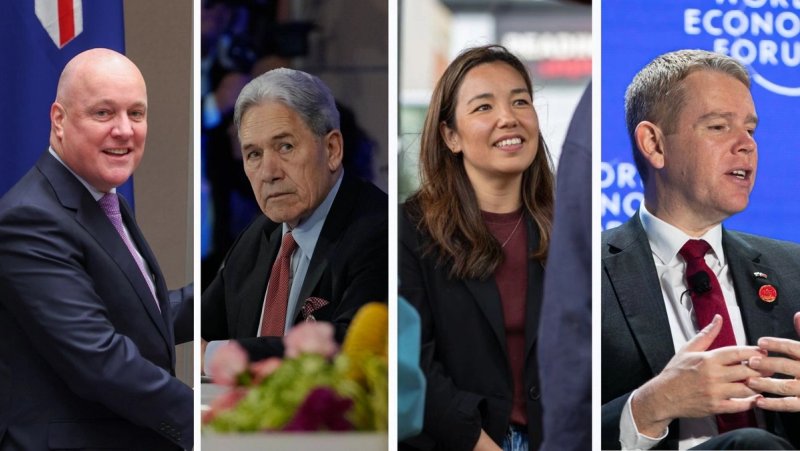
From left: New Zealand National leader and Prime Minister Christopher Luxon, New Zealand First leader and Foreign Minister Winston Peters, Opportunity leader Qiulae Wong, Labour Party leader Chris Hipkins (MEA Photo, ASEAN Secretariat, Opportunity, WEF)
The gulf between the two political blocs is even wider on climate change.
Labour, together with the Greens, had promised to push ahead with policies to address climate change, including reinstating the ban on oil and gas drilling, reform the Emissions Trading Scheme and align it with New Zealand’s Paris Agreement targets.
So it could be very awkward when New Zealand’s ministers and representatives show up at these meetings being held during this limbo period. On climate change the two blocs are polar opposite, so New Zealand will be able to sit and watch. But at APEC and other similar trade-related forums, it’ll be in the room but not really at the table. This should concern New Zealanders, because as Carney memorably said (Opens in new window): “If you’re not at the table, you’re on the menu.” And who knows what the world will look like when APEC rolls around next year?
Anna Fifield is a New Zealand journalist, writing a newsletter (Opens in new window) “Between Giants” about New Zealand’s place in the world, and a non-resident fellow at the Center for Strategic and International Studies.