This month, Prime Minister James Marape proposed encouraging (Opens in new window) Papua New Guinean families to have no more than three children. He has since clarified (Opens in new window) that no three-child policy has been introduced and that families remain free to decide. But that freedom does not downplay the demand for family planning in the country.
Interestingly, three children is already close to what many PNG women want. The 2016–18 Demographic and Health Survey (Opens in new window) recorded a total fertility rate of 4.2 births per woman, against a wanted fertility rate of 3.0. Approximately 28% of all women identified their last birth as unplanned. With PNG’s roughly 255,000 annual births (Opens in new window) – a figure closer to the UN estimate than the 230,000-population growth figure cited earlier in the piece – an estimated 71,000 babies are born unplanned each year. Helping women close that gap would advance the Prime Minister’s aim while respecting their choices.
Successive governments have recognised the importance of family planning; implementation has repeatedly fallen short.
To achieve the goal, knowledge alone is insufficient. 88% of currently married women (Opens in new window) knew at least one contraceptive method, yet only 31% use a modern method. And around one quarter had an unmet need for family planning. What is the value of an awareness campaign about family planning if a woman who is already seeking contraception cannot obtain it.
In 1982 (Opens in new window), the National Executive Council abandoned PNG’s national family planning program and delegated its activities to provincial governments, where its status declined further. Three national population policies followed. The most recent covered 2015 to 2024. Successive governments have recognised the importance of family planning; implementation has repeatedly fallen short.
Other policies are supportive of family planning. PNG’s Sexual and Reproductive Health Policy (NSRP (Opens in new window)) already calls for free access to modern contraceptives in all health facilities, every day of the week. My family planning report for RESET@50 Program (Opens in new window) sets out how to make that commitment work through a National Voluntary Family Planning Program. Cabinet should fund this program while commissioning the fourth National Population Policy.
Some financing is already in place. In April, PNG renewed its Supplies Compact (Opens in new window) with United Nations Population Fund (UNFPA) for 2026 to 2027, committing US$1.52 million towards reproductive and maternal health commodities in 2026. A protected family planning budget must also pay for distribution, trained staff and outreach.
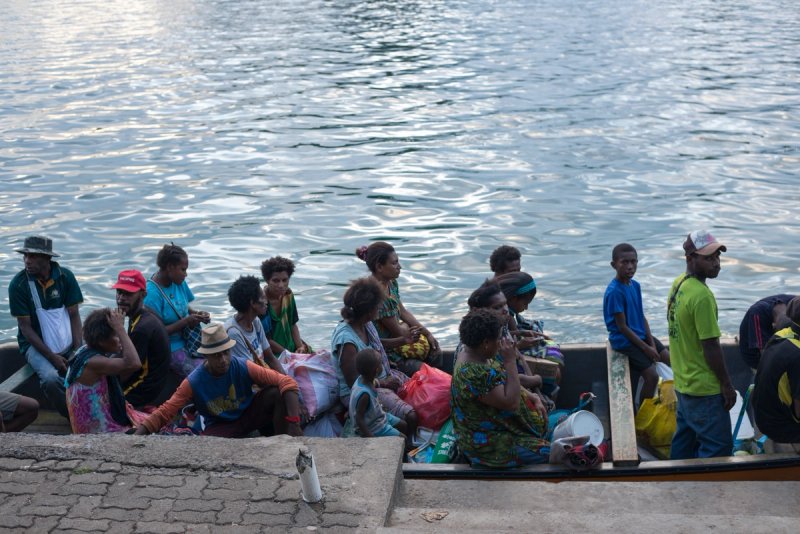
Returning home to Krangket Island in Madang, Papua New Guinea (Joel Carillet/Getty Images)
At the centre of the family planning agenda is reliable delivery. In 2024, UNFPA reported persistent shortages (Opens in new window) of family planning commodities at service delivery points in PNG. It described efforts to improve ordering, stock management and distribution. These are practical constraints that a speech about family size cannot resolve.
The phrase “three children per family” also glosses over PNG’s family structures. Roughly one in five currently married women (Opens in new window) had a husband with another wife – a practice that is widespread (Opens in new window) in the country. What would “three children per family” mean in such circumstances? Three for each woman, or three across a man’s marriages? This ambiguity shows why policy should begin with each person’s reproductive choices. Polygyny also makes men’s responsibilities to all their children an essential part of any discussion about affordability.
In any eventual policy, Marape’s assurance (Opens in new window) that children from larger families will retain access to public services should be explicit. Every child needs education and healthcare. And parents must be able to seek family planning without fearing punishment, and health workers should be assessed on service quality and informed consent. Implementing birth quotas would create incentives that undermine those goals. Couples should be provided with an enabling environment to choose the number of children they want, instead of prescribing any number to them. A voluntary family planning program would do.
The economic gains will also depend on wider reforms. Helping families avoid unintended pregnancies can give them more scope to invest in their children. Giving a strong start in life for a kid in PNG is still a luxury. It cost about K127,000 (Opens in new window) to give a child a decent upbringing from childhood to adulthood. Not only that, but it also allows women greater control over education and work.
So it’s good that the Prime Minister himself has opened a useful discussion. He can now give it substance by backing a program that women can reach, trust and choose to use. The missing measure of success is how reliably Papua New Guineans can make an informed decision whether and when to have a child – matching their wanted and actual fertility rate – that’s their untold demand.