|AUKUS: Is there a Dickie Williams in the building?
AUKUS: Is there a Dickie Williams in the building?
Australia’s former Chief of the Defence Force Admiral Chris Barrie has delivered a damning assessment of AUKUS. As a commissioner of the unofficial public inquiry (Opens in new window) into the nuclear-powered submarine program, he has called (Opens in new window) for the project to be scrapped, questioning its strategic rationale and the failure to examine alternatives.
Barrie’s intervention raises a pointed question. Are similar doubts being expressed within Australia’s defence establishment? Because AUKUS commits Australia to a particular conception of its strategic future, with profound consequences for the capabilities and industrial resources available for its defence.
Australian history offers an instructive example of what can happen when political commitments to an alliance take precedence over clear-headed assessments of national defence requirements.
The lesson for AUKUS is not that Australia should abandon its alliances, but that the country’s strategic requirements must determine its defence acquisitions, rather than the reverse.
In the 1930s, Australia’s defence policy assumed that British naval power, operating from Singapore, would protect the continent against Japanese aggression. Two senior Australian officers questioned that assumption.
Richard “Dickie” Williams, the RAAF’s first Chief of the Air Staff, believed Australia’s geography demanded a different approach. Long-range reconnaissance and striking aircraft were needed to defend the maritime approaches to the continent. His strategic priorities lay in New Guinea and the Coral Sea – Australia’s “theatre of destiny” – rather than Singapore.
In the Army, then Major General John Lavarack warned that Britain, preoccupied with a European war, might be unable to send a fleet to the Pacific when Australia most needed it. Neither officer advocated abandoning Britain, but both questioned whether imperial priorities adequately served Australia’s defence.
These disagreements were not confined to abstract questions of strategy. Both officers eventually lost their jobs, although neither lost his career. Williams was removed ostensibly because of the RAAF’s poor safety record, in circumstances that appeared politically convenient.
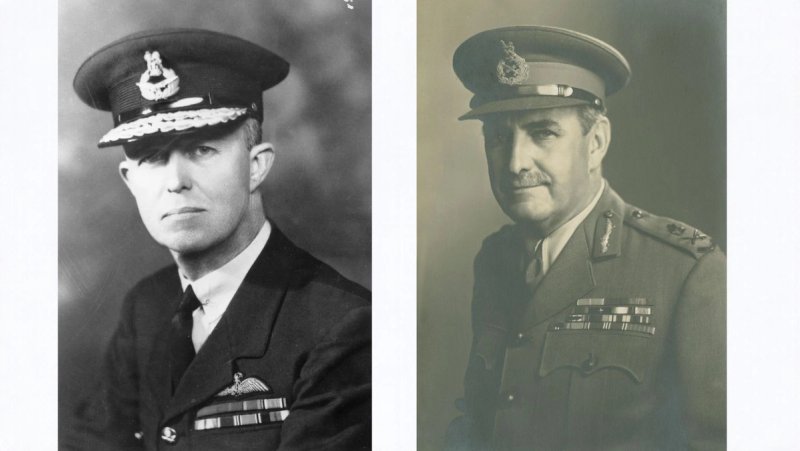
Air Marshal Richard “Dickie” Williams and Lieutenant-General John Lavarack (Australian War Memorial, State Library of QLD)
The strategic arguments lost by Williams and Lavarack had industrial consequences. In the late 1930s, Australian businesses led by BHP’s Essington Lewis set out to establish a modern aircraft industry, with the active support of Williams. The result was the Commonwealth Aircraft Corporation (CAC), whose chief engineer Lawrence Wackett, favoured American aircraft technology as better suited to Australian requirements. CAC began manufacturing the American-designed Wirraway, and its Wasp engine, while the RAAF ordered Lockheed Hudson bombers in 1938.
But Australia’s High Commissioner in London, Stanley Melbourne Bruce, pressed instead for local manufacture of the British Bristol Beaufort bomber. The determination of the government to reinforce imperial ties was evident in the strange organisation established to deliver it: CAC, created by private investors, was sidelined in favour of state railway workshops converted into aircraft factories. Production suffered long delays, especially because Bristol could not supply engines, forcing Australian engineers to substitute American powerplants – built by CAC. By the time Beauforts were delivered in numbers, they were too far behind schedule to meet the crisis of late 1941 and early 1942.
More than a choice between British and American aircraft, this episode concerned Australia’s capacity to develop an aviation industry responsive to its own defence requirements rather than the priorities and technological limitations of its principal ally.
Williams’s alternative went further. In 1939 he proposed a home-defence fighter squadron equipped with aircraft produced by CAC. His successor, the British officer Charles Burnett, brought out of retirement to command the RAAF, abandoned the proposal. He remodelled the service as a training arm for the RAF under the Empire Air Training Scheme.
In a minor irony of history, on 19 February 1942, Williams happened to be in Darwin. In his memoir – pointedly titled (Opens in new window)These Are Facts – he recalled watching on helplessly as the Japanese bombed the port and airfield, without opposition from RAAF fighters; indeed, Australia had none of its own anywhere in the country. It was a bitter illustration of the consequences of decisions Williams had challenged.
AUKUS commits Australia to a strategic and industrial path dependent for decades on American and British technology, production capacity and strategic cooperation. But what strategic requirements justify that commitment? Is Australia’s contemporary “theatre of destiny” in its maritime approaches, or in the Taiwan Strait, where nuclear-powered submarines are clearly intended to contribute to American operations in a conflict with China?
The experience of Williams and Lavarack is instructive because they recognised fundamental weaknesses in Australia’s defence policy and developed alternatives grounded in the country’s geography, capabilities and national interests. Their strategic assessments proved prescient when Britain’s Singapore strategy collapsed in 1942, leaving Australia dangerously exposed to Japanese attack.
The lesson for AUKUS is not that Australia should abandon its alliances, but that the country’s strategic requirements must determine its defence acquisitions, rather than the reverse. The 2026 National Defence Strategy (Opens in new window) emphasises self-reliance and the defence of Australia’s northern approaches but unconvincingly accepts AUKUS will deliver that posture. If history repeats, the first time as tragedy, we have to hope the second time will not be farce.