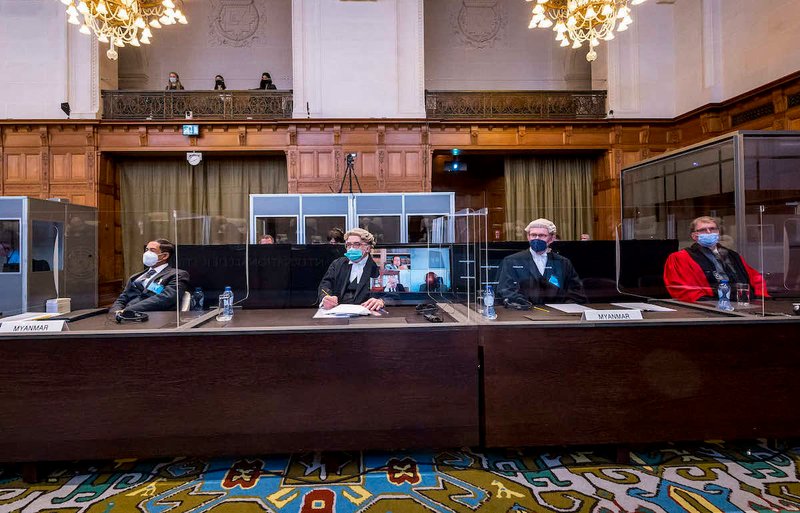
There are four key problems with this approach.
First, it does not reflect the status quo. Previously, Aung San Suu Kyi represented Myanmar in the court as the leader of a nominally civilian government led by her National League for Democracy (NLD). For all the problems with the NLD government and its approach at the court, it was democratically elected in a landslide in 2015, which was repeated at the elections in 2020. To suggest that having delegates of the military junta that overthrew that government represent Myanmar is the status quo is a clear misreading of the process.
Second, the ICJ is the “principal judicial organ” of the United Nations and therefore there is an argument to be made that its approach should be consistent with other UN organs such as the General Assembly. The United Nations is a single legal entity, notwithstanding the formal legal equality and separation of its organs, and it is logically inconsistent, to say the least, to have the junta represent the state of Myanmar before one UN organ, while the NUG represents Myanmar before another.
Third, and more importantly, this is not only a legal case, it is political theatre. Aung San Suu Kyi understood this keenly when defending Myanmar and the military at the international court as part of her nationalist re-election campaign at home. The global media coverage of the military junta speaking for Myanmar, and the President of the Court referring to their appointed agent as “Your Excellency”, confers a perception of legitimacy upon the junta, regardless of debates over legal minutiae.
Fourth, it has led to delays in considering the substance of the proceedings. The military junta has continued Aung San Suu Kyi’s preliminary objections in the case, arguing that The Gambia was acting as a “proxy” for the Organisation of Islamic Cooperation, and also that it lacked standing to bring the case.
In contrast, the NUG has withdrawn the preliminary objections and contends that UN Ambassador Kyaw Moe Tun, who supports the opposition, is “the only person authorised to engage with the Court on behalf of Myanmar”.
As Yanghee Lee, former UN special rapporteur on human rights in Myanmar, has argued:
These hearings, with the junta claiming to represent Myanmar, are a disgrace. [The preliminary] objections are the focus of these hearings and will require several months of deliberation by the judges. The Court should instead recognise the NUG’s authority, formally dismiss the objections and move swiftly to dealing with the actual substance of the case, the atrocities against the Rohingya people.
Unfortunately, with proceedings having commenced, it is very unlikely the court will direct a change in representatives for Myanmar’s defence. Proceedings were already likely to take many years to reach any conclusion. Now, with months of wasted time to come debating the preliminary objections, Myanmar’s long suffering Rohingya will need to accommodate the glacial pace of international law before achieving any semblance of justice.
Adam Simpson , Juliette McIntyre