In May 2025, Beijing pledged $2 million for Pacific climate cooperation with 100 “small and beautiful” community projects over three years (Tian Yuhao via Getty Images)
The climate card China has yet to play
As Washington closes visa pathways for Pacific islanders, Beijing has money, technology and experience to offer new ones.
Newsletters
Subscribe to The Informer for monthly expert analysis, and to Events for advance notice of visiting world leaders and distinguished guests.
You may unsubscribe from Lowy Institute newsletters at any time. For information on our privacy practices and how to unsubscribe, see our Privacy Policy.
No region has been as vocal and consistent on impact of climate change on habitability and migration as the Pacific. Shifting weather patterns with more frequent and violent storms as well as rising sea levels are depriving populations of their homes and forcing them to seek a new life elsewhere. In 2025, the Pacific Islands Forum endorsed an implementation plan for its Pacific Regional Framework on Climate Mobility, including a regional Climate Mobility Action Hub, peer learning on planned relocation, and financing for national action. Vanuatu and Fiji are already building planned relocation into national policy. Australia has struck a deal with Tuvalu for a migration pathway, giving Canberra a say in Tuvalu’s defence agreements with third countries.
The Pacific is also a hotbed of US-China competition. Solomon Islands and Kiribati switched recognition from Taiwan to China in 2019, and Nauru followed in 2024. Climate mobility is quickly becoming part of that bargain. Under the Compact of Free Association, citizens of the Marshall Islands and Palau, two of Taiwan’s remaining partners, can move freely to the United States in exchange for US defence rights.
But Washington has also been in swift retreat from international climate policy. In January, the Trump administration announced US withdrawal from the UN Framework Convention on Climate Change and the Intergovernmental Panel on Climate Change, having already left the Green Climate Fund the year before.
Previously, Washington noticed that climate mobility would be a smart diplomatic play. Under the Biden administration, the White House released the first-ever US government report (Opens in new window) on how climate change affects migration, set up an interagency working group, and was close to launching a US Climate Mobility Plan of Action.
That work has now been reversed. As Foreign Policy reported (Opens in new window), Washington made legal migration pathways for Pacific Islanders less predictable in 2025. Tuvalu, Tonga, and Vanuatu appeared on a State Department visa-restriction list, and Fiji was caught up in a January 2026 suspension of immigrant visas. The United States is closing the very pathways that Pacific states say they are relying on as an adaptation strategy (Opens in new window).
This retreat comes at a fortuitous time for Beijing. In 2028, COP33 will be hosted by an Asia-Pacific country, and the field has opened wide with India’s withdrawal (Opens in new window). China is reportedly weighing a bid (Opens in new window). If precedent holds, the summit would open days after the next US presidential election. If Beijing wants to make a splash beyond the predictable (green technology, climate finance, the second Global Stocktake), it could do something no presidency has done before: put climate mobility at the centre of the summit.
Beijing has reasons to be hesitant. Elevating its relocation record to the global stage would invite scrutiny of documented human rights concerns.
China already has the building blocks. In May 2025, Beijing announced $2 million for Pacific climate cooperation, 100 “small and beautiful” community projects over three years, and pledged to collaborate (Opens in new window) on early warning and coastal protection, including disaster monitoring from its weather satellites.
Beijing also has technical expertise others desire. It has created “sponge cities,” designed to absorb heavy rainfall and prevent flood-displacement, with measurable improvements in pilot cities’ resilience. And China has conducted planned relocation at a scale and speed no other country has matched: between 2015 and 2020, China relocated 9.6 million (Opens in new window) people, including (Opens in new window) many from disaster-prone areas.
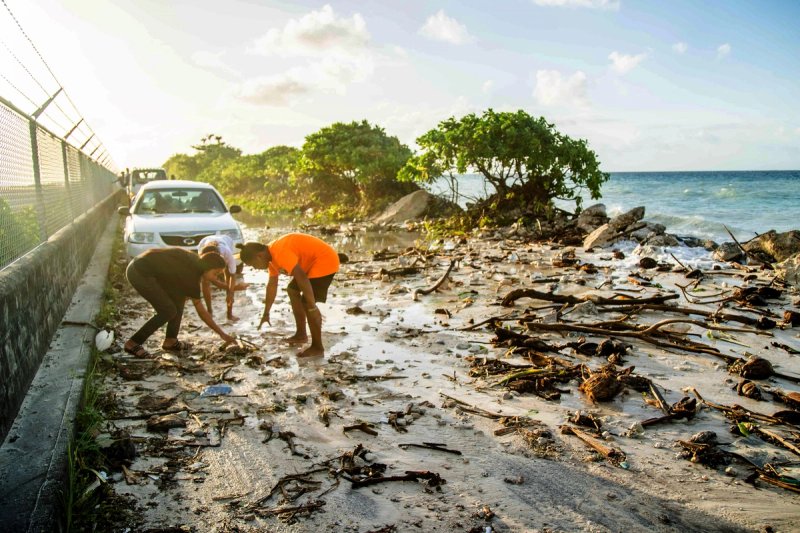
High-tide flooding and debris cover the road to Majuro’s airport in the Marshall Islands, 5 December 2021 — a scene recurring more often across the Pacific’s low-lying atolls as sea levels rise (Chewy Lin/AFP via Getty Images)
Together, these efforts would amount to a climate mobility strategy. A COP presidency could bundle them into one package: funding for the Pacific’s Climate Mobility Action Hub, technical expertise for communities trying to stay, and planning support for those that have to move. Bolder still, as Washington continues to shrink visa access for countries, Beijing could instead open temporary labour pathways for its most climate-exposed partners.
Beijing has reasons to be hesitant. Elevating its relocation record to the global stage would invite scrutiny of documented human rights concerns and open questions about community consent. Beijing has also shown little appetite for the politics of migration, preferring to help countries keep people in place, backing Pacific claims that their statehood (Opens in new window) survives rising seas.
While Beijing deliberates, others are making a play. In August, New Zealand committed NZ$17.9 million (Opens in new window) (roughly US$10 million) to a Pacific Climate Mobility Partnerships Program. Despite this, it is clear that no middle power can match China’s money, technology, and relocation experience.
For China, with existing inroads across the Asia-Pacific, climate mobility is a unique opportunity: a cogent strategy would draw upon established policy and speak directly to the needs of partner governments. Pacific Island states hold a dozen UN seats and carry real weight in a climate process that runs on consensus.
Ultimately, Beijing may decide that seawalls and satellites are enough and that an explicit climate mobility agenda carries more risk than reward. But Washington (and Canberra) should not count on it. If the United States won’t help Pacific countries plan for climate mobility, China has the tools to do so, and COP33 may give it the stage.