Guo Jiakun, a spokesperson for the Chinese Ministry of Foreign Affairs, said in the wake of Solomon Islands' decision that China avoids “geopolitical rivalry or bloc confrontation in cooperation” in the Pacific (Johannes Neudecker via Getty Images)
What will China learn from Australia–Solomon Islands treaty?
A switch from China to Australia may look like Beijing’s loss, but the Pacific lesson runs deeper.
The 2022 security agreement between Honiara and Beijing had raised concerns about China’s growing security presence in the Pacific. The new deal signals a closer foreign policy alignment (Opens in new window) with Australia under Solomon Islands Prime Minister Matthew Wale.
For China, the episode may represent a setback, despite Beijing not necessarily seeing its relationship with Australia as a competition. China has (Opens in new window) earlier observed that the two countries have “their own unique strengths and advantages”, and “there is enough space in the vast Pacific Ocean” for both to play a role.
That position was reiterated in China’s response (Opens in new window) this week to Solomon Islands’ decision. China stressed that its cooperation with Solomon Islands follows “the principle of mutual respect and equality” and avoids “geopolitical rivalry or bloc confrontation in cooperation” in the Pacific.
China’s challenge is not simply to compete with Australian dollars using Chinese renminbi, but to develop forms of engagement that advance its broader diplomatic objectives.
Nevertheless, the episode offers several lessons for China, illustrating the political realities of the Pacific and the limitations of Beijing’s approach to the region.
By contrast, Australia’s relationship with Solomon Islands dates back to its independence in 1978. Through decades of development assistance, engagement with local communities, and deployment of military personnel and police, Australia has developed a degree of familiarity and trust that China cannot quickly replicate.
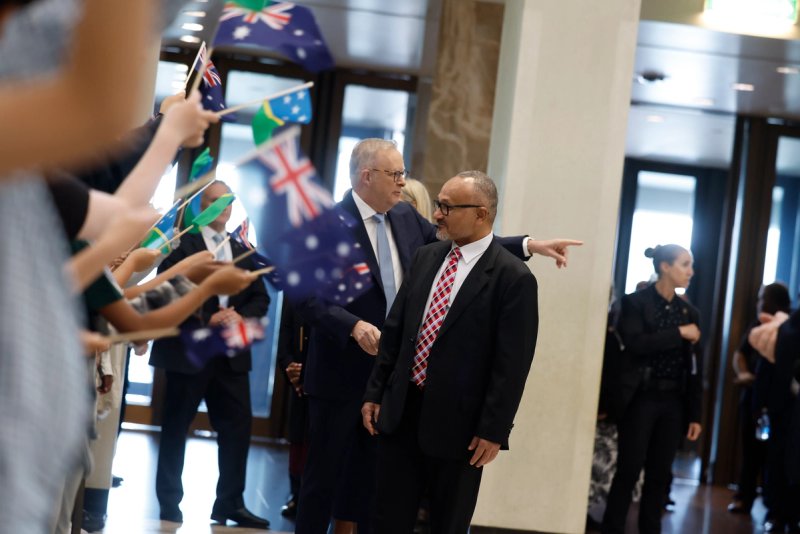
Prime Minister Anthony Albanese and Prime Minister of the Solomon Islands Matthew Wale (r) arrive into Parliament House on 25 November 2026 in Canberra, Australia (Hilary Wardhaugh/Getty Images)
China has certainly made progress in the region, but becoming a trusted and enduring partner requires more work.
Part of the challenge lies in how Beijing has understood the Pacific. China’s engagement has often been situated within its broader diplomacy towards the developing world, including the Belt and Road Initiative and concept of the Global South. Under Xi Jinping’s Global Development Initiative (Opens in new window), the Pacific Islands region is regarded as part of China’s wider effort to support developing countries in pursuing “independent and sustainable development”.
While this framework provides a coherent logic for China’s overseas engagement, it can also obscure the region’s political and social dynamics, where people-to-people relationships, local cultural knowledge and historical experience are valued.
Second, China needs to keep adapting its approach.
China is unlikely to withdraw from Solomon Islands simply because its security agreement is ending. China’s ambassador in Solomon Island spoke on 18 November at the handover ceremony (Opens in new window) for the China-aided Auki Road Project, demonstrating China’s continued presence.
China does need to consider what kind of partnership it can offer that is attractive to Pacific Island countries, recognising that it cannot easily replicate Australia’s longstanding presence.
There are signs that Beijing is moving in this direction. When I interviewed (Opens in new window) several Chinese scholars in 2024, many acknowledged that Beijing had underestimated Australia’s reaction to the 2022 security agreement, prompting greater recognition of the need to account for regional sensitivities. Likewise, data from the Lowy Institute’s Pacific Aid Map (Opens in new window) also suggests that Chinese aid projects have become smaller on average, with a greater share directed towards more locally targeted initiatives.
The new Australia–Solomon Islands treaty raises the stakes further. Australia’s comprehensive package combines security cooperation with political and development commitments. China’s challenge is not simply to compete with Australian dollars using Chinese renminbi, but to develop forms of engagement that advance its broader diplomatic objectives without unnecessarily turning regional relationships into geopolitical contests.
Finally, China needs to understand how Australia perceives its actions.
During my recent time in China, I was frequently asked by Chinese scholars why Beijing’s message had not been better understood in Australia.
Similarly, some struggled to understand why Solomon Islands’ decision was considered a “massive win” for Australia.
Chinese diplomats (Opens in new window) and scholars (Opens in new window) have repeatedly said that China does not seek “geopolitical rivalry” in the Pacific. However, from an Australian perspective, this message can be difficult to reconcile with China’s behaviour. The Chinese military’s missile test in the Pacific in July, for example, attracted attention (Opens in new window) and reinforced concerns about China’s growing strategic presence in the region, though the test itself was not widely discussed in China in the context of Australia–China relations.
Among Chinese experts, securitisation in Australia remains a common explanation for why Beijing’s intentions are viewed with suspicion. But the problem may not simply be that China needs to communicate its intentions more clearly. It may also need to consider why its actions produce interpretations that differ from its stated intentions.
This requires something more difficult than better messaging: strategic empathy. China needs to understand how its actions are perceived by countries that do not share its assumptions about its role in the region.
Solomon Islands’ decision therefore may not be a setback for China. Instead, it is an opportunity to reflect on how to engage with the Pacific, a region that is long peripheral to China’s foreign policy and about which Beijing still has much to learn.
Dr Edward Sing Yue Chan is a Postdoctoral Fellow at Australian Centre on China in the World, Australian National University and the Associate Editor of The China Journal.