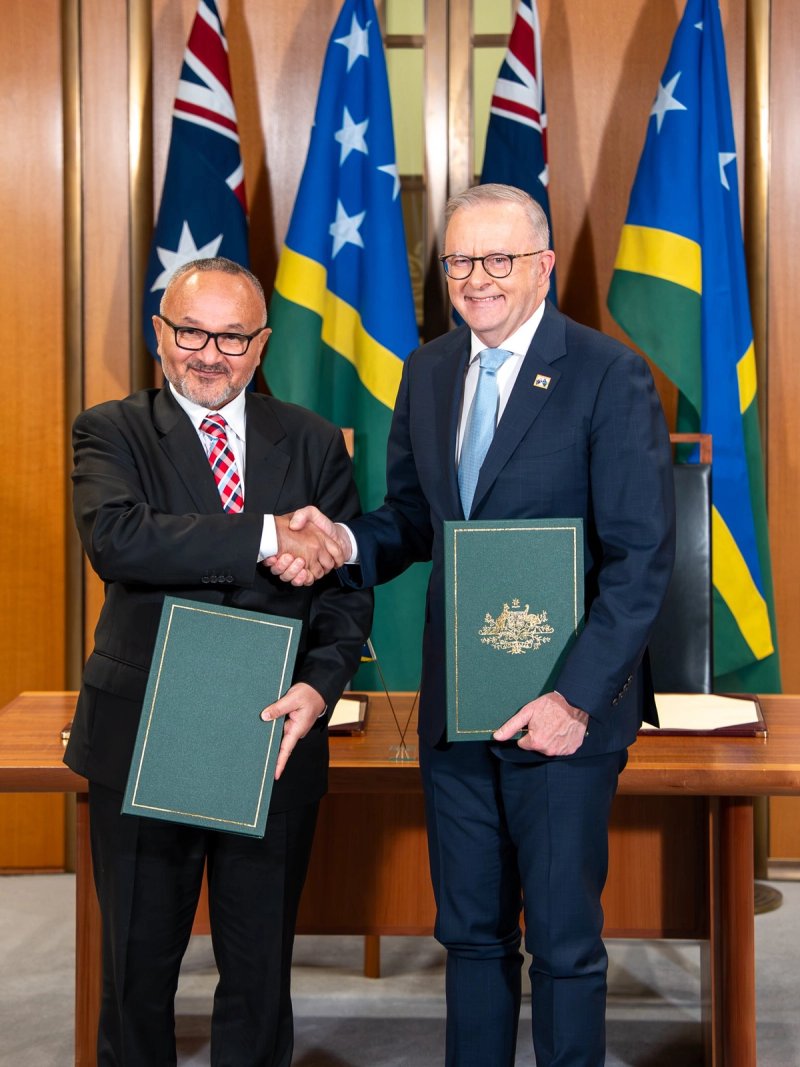
It is indeed a marked turnaround from the previous Australian government in bilateral relations (Hilary Wardhaugh/Getty Images)
Power, influence and the Australia–Solomon Islands treaty
Behind the security language, the Australia–Solomon Islands treaty is really a bet on local economic power.
Newsletters
Subscribe to The Informer for monthly expert analysis, and to Events for advance notice of visiting world leaders and distinguished guests.
You may unsubscribe from Lowy Institute newsletters at any time. For information on our privacy practices and how to unsubscribe, see our Privacy Policy.
|Power, influence and the Australia–Solomon Islands treaty
Power, influence and the Australia–Solomon Islands treaty
Today, Australia and Solomon Islands signed a new treaty (Opens in new window) in Canberra with a large delegation of 14 senior Solomon ministers and several other MPs and officials. The treaty has the potential to shift power and influence – domestically and regionally.
The details of the treaty follow the formula of Australian Pacific pacts (Opens in new window) – Australia’s security interests in exchange for political and development investments requested by Pacific leaders. Solomon Prime Minister Matthew Wale and his political party’s key campaign promise – free education – is advanced in exchange for assurance that the Solomon–China security pact will expire rather than be renewed in early 2028 and that Australia is the country’s “primary security partner”.
The treaty also includes mentions of renewable energy, a sovereign wealth fund, infrastructure, Technical and Vocational Education and Training (TVET) and labour mobility, plus people-to-people ties and economic interactions in creative and sports sectors. Indigenous and South Sea Islander relations are explicitly mentioned, and Pacific Islands Forum mechanisms are presented around regionalism and security.
Influence will peak and wane with political and geopolitical changes, whereas integration is steady and holds the greatest promise.
The multi-level focus of investments can be looked at cumulatively to assess its impact. Fee-free education for a country where 64% of the population is under 30 years of age has value at several levels.
First it will advance the ability of young people to finish school, pursue TVET or university education.
Second, school fees are often the largest cash expense for rural families, and even for the urban middle class, families with several children struggle with fees from private or government providers.
Third, many families have relied on scholarships doled out by their Member of Parliament to send their children to university. This has also often created headaches for tertiary providers as well, with long lists of unpaid fees.
So, with fee-free education there would be more potential for people to vote without that choice being consequential for whether their children could be enrolled in education. For Wale, it will demonstrate that he did indeed deliver on something national and practical, which can feel like a rarity in the instability of Solomon politics.
In the run up to the treaty signing, there was talk about budget backing for Constituency Development Funds (CDF). The substantial impact of CDF on power is that it can support incumbents in elections by allowing them to make handouts and spend money in the run up to elections. Relief of the need to rely on incumbent MPs for education fee support through fee-free education may be moderated if there is also large spends under treaty arrangements on CDF and this is used to influence votes.
The treaty’s focus on “transformational economic growth and prosperity” holds better potential to bridge gaps between economic growth and poor levels of access to key services education, health and policing. Solomon Islands’ economy is driven by extraction (logs, minerals and fish) and foreign control of each of these extractive industries (plus retail where foreign traders dominate the sector). Governance over each of these sectors is problematic, and economic benefits retained locally and used effectively can be low. Chinese and foreign corporate influence can be seen in extractive sectors, related government functions – notably around trade, tax and migration – and close relations between some MPs and extractive companies.
Solomon Island Prime Minister Matthew Wale and Australia's Anthony Albanese after the treaty signing in Canberra (@AlboMP/X)
For Wale and his ministers, the key to trading today’s pact into political wins at the next election will be making sure fee-free education is indeed delivered. This will require a focus now on domestic issues, keeping MPs rowing in the same direction, and pushing for implementation of economic transformation and fee-free education. Key will be that fee free education does not weaken the institutions it is meant to support, includes local ownership, is implemented carefully and is sustainable, as pointed out by leadership (Opens in new window) at Solomon Islands National University.
For Australia, Prime Minister Anthony Albanese and Foreign Minister Penny Wong can take the political win of the treaty, which is indeed a marked turnaround from the previous Australian government in bilateral relations and delivers a treaty that goes beyond intervention (as was the focus of the previous one (Opens in new window)) towards integration.
Through education, labour mobility and work, local contracting of aid and infrastructure, support of niche agricultural and locally made exports and development of Solomon-run services, Australia can support both indigenous empowerment and economic benefits for both countries. Whether increased access to education and other treaty investments can change the economy from extraction to indigenous empowerment will be critical to determining power and influence in Solomon Islands beyond the row of bilateral pacts.
If economic benefits are generated this could lessen local grievances about foreign exploitation which can lead to violence (Opens in new window), reliance on extractive industries, and take some of the sting out of political debates linked to preferences for different donors. Influence will peak and wane with political and geopolitical changes, whereas integration is steady and holds the greatest promise for Australia–Solomon relations.
Dr Anouk Ride is a sociologist with an interest in development and peace and conflict in the Pacific Islands region. She was based in Solomon Islands for two decades doing policy orientated research and has managed over 20 projects with Pacific governments, media, police and correctional services, regional organisations and universities.