A cold lava flood path from Mount Semeru following heavy rain at Jugosari village, Lumajang, East Java, 29 October 2026 (Hayu Yudha/AFP via Getty Images)
Australia needs Asia expertise to see how disasters become security crises
Language enrolments have collapsed – taking with them a capacity to read a regional crisis before it becomes one.
Newsletters
Subscribe to The Informer for monthly expert analysis, and to Events for advance notice of visiting world leaders and distinguished guests.
You may unsubscribe from Lowy Institute newsletters at any time. For information on our privacy practices and how to unsubscribe, see our Privacy Policy.
|Australia needs Asia expertise to see how disasters become security crises
Australia needs Asia expertise to see how disasters become security crises
Consider two potential environmental risks. One unfolds slowly on Indonesia’s Java coast, the product of slow-moving changes and human activity, while the other could emerge suddenly from a megathrust earthquake that destroys much of the east coast of Japan from Tokyo to Kyushu.
How international partners choose to respond to these calamities should rely upon people who understand how neighbouring societies work: their languages, political institutions, social relationships, and competing explanations of disaster. But these are assets that Australia is lagging or allowing to wither.
A sophisticated security scenario must ask questions that remote sensing cannot answer. Who decides whether a neighbourhood is protected or relocated? How might displaced families negotiate access to housing and employment? Will established neighbourhood organisations mediate tensions, or will unequal access to resources sharpen them?
Local language proficiency is integral to those answers. Yet Australia is losing that capacity. A 2026 parliamentary inquiry (Opens in new window) reports that domestic university enrolments in Southeast Asian languages fell 75% between 2005 and 2024, and calls for sustained investment in Asian languages, area studies and research training. The decline is a broader vulnerability (Opens in new window), not simply an education problem.
Our research in Kendal in Indonesia showed how official communications repeatedly characterised tidal inundation as a “natural disaster”, obscuring human contributions to subsidence.
The scenario for Japan offers a revealing contrast. Language matters too, but a major Nankai Trough earthquake is a longstanding seismic hazard, not a consequence of climate change. Yet its impact would certainly cause massive and long-lasting disruption to electricity, ports, medical services and supply chains, compounded by factors such as an ageing population and climate-related extremes and the need to deal with unfathomable deaths and injuries, even allowing (Opens in new window) protection measures enacted after the 2011 tsunami. Those disruptions would quickly reach Australia, given Japan’s place as one of its largest trading partners, a major buyer of Australian energy and a close defence partner.
Japan has already had a preview of how uncertain the social response can be. In August 2024, its first official Nankai Trough megaquake advisory triggered panic buying, cancelled holidays and confusion about what residents were meant to do, even though no major quake followed.
The decisive questions are social and institutional as well as technical. Which industrial capabilities can be restored quickly? How do prefectural and national authorities allocate scarce resources? What assistance would Japanese institutions welcome, and what would they resist? Without Japanese language expertise, institutional knowledge and trusted relationships, Australia risks mistaking a damage estimate for a recovery forecast. Machine translation can reproduce words, but cannot reliably judge whose account carries authority or why an institution might hesitate.
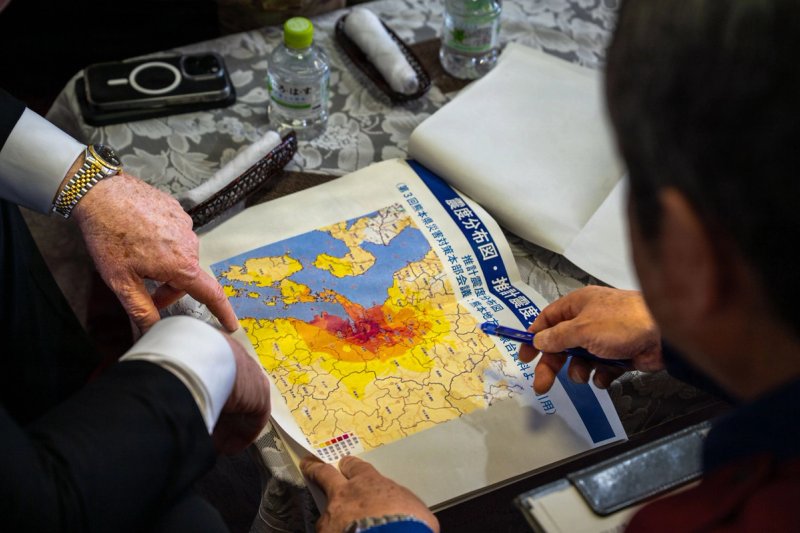
Assessing the the impact of a Kumamoto earthquake in August 2026 (Tristan Truesdell/DVIDS)
These are not challenges being confronted in isolation. In January, the UK government published a national-security assessment (Opens in new window) warning that ecosystem degradation can cascade through food and water insecurity, disease, migration, economic disruption and geopolitical competition. It identifies Southeast Asian coral reefs and mangroves among ecosystems of strategic importance, judging that there is a realistic possibility of coral-reef collapse beginning from 2030 and mangrove collapse from 2050, allowing these are explicitly uncertain scenarios, not predictions with fixed deadlines.
The UK report’s most useful lesson for Australia is not its warning but its method. It distinguishes confidence in environmental trends from much greater uncertainty about how societies and governments will respond. Such distinctions cannot be answered from hazard maps and economic models alone.
Our research in Kendal (Opens in new window) in Indonesia showed how official communications repeatedly characterised tidal inundation as a “natural disaster”, obscuring human contributions to subsidence and making some interventions harder to discuss. That framing matters for any scenario. If inundation is officially “natural”, groundwater regulation slips off the agenda, and a scenario built only on official sources would likely underestimate how fast subsidence will continue. Indonesia’s everyday practices of neighbourhood mediation are a form of social infrastructure (Opens in new window), one that can contain grievances but can also exclude outsiders. Our current fieldwork suggests that understanding local communications and relationships can change a scenario as much as another climate projection.
This is why Asia capability should be treated as infrastructure for national-security analysis. Like the neighbourhood mediation that holds Javanese communities together, it is largely invisible until it is missing. It allows teams to test competing scenarios against local journalism, official documents, scholarship and networks. It enables us to spot political assumptions hidden in models, while specifying what remains uncertain.
Rebuilding that capacity will take more than goodwill. Three steps would help. National-security agencies should embed regional specialists in scenario and foresight teams, rather than consulting them after the modelling is done. Funding for Southeast Asian languages should be multi-year and tied to research training, not delivered as one-off grants. And agencies should build lasting partnerships with universities and in-country researchers, so that trusted relationships exist before a crisis rather than being improvised during one.
Britain has recognised that distant ecological shocks can become national-security crises. Australia must add the regional knowledge needed to understand how such shocks travel through actual societies. The best scenarios do not claim to know the future. They identify plausible pathways, decision points and opportunities to prevent a crisis from escalating.