Countries can place conditions on AI companies being able to work within its boundaries (Marcus Reubenstein/Unsplash)
Australia wants to regulate AI the way it tamed social media
Beneath talk of a great-power contest, smaller democracies are steadily building the leverage to set their own terms on AI.
Newsletters
Subscribe to The Informer for monthly expert analysis, and to Events for advance notice of visiting world leaders and distinguished guests.
You may unsubscribe from Lowy Institute newsletters at any time. For information on our privacy practices and how to unsubscribe, see our Privacy Policy.
This seemed to be a moment where Washington was signalling its interest in building a network of AI capacity across the region rather than exporting dependency. These investments were seen as a bulwark (Opens in new window) against Chinese AI.
Just weeks after that agreement, US President Donald Trump threatened a “tremendous tax (Opens in new window)” on American companies that build data centres overseas.
Countries around the region would still be able to access these American models, but the job creation and infrastructure development that Trump claims come along with those centres would not flow out to anyone else.
Access to technology and control over its development are different things.
As Australia, India, and Japan tried to make sense of Trump’s announcement, they are reminded of the central geopolitical question of the AI age, of how much agency countries outside of the US and China possess in this space.
The day before Trump’s threat to penalise American companies that build AI infrastructure overseas, the Philippines had answered this question in their own way.
The Philippines has already signed on to Trump’s Pax Silica agreement. But those commitments only go so far.
Most countries around the Pacific are starting to reject Trump’s premise that the AI race is solely a matter of the US and China. These technologies affect their countries and their citizens too, and middle powers are now demanding influence over the outcomes.
This has become one of the chief frustrations in middle powers across the world.
AI has transformed economies, but its development has felt amorphous and uncheckable. Even while voters in Victoria’s upcoming election are concerned about data centres (Opens in new window), their concerns about the AI industry as a whole have nowhere to go.
As Australia has done with social media companies, countries can place conditions on AI companies being able to work within its boundaries. Those access conditions matter a great deal for wealthy countries like Australia, on whose markets AI companies are betting for large future growth. Local governments can use their zoning and permitting power to place requirements on the infrastructure being developed by these companies.
But little of this work matters in isolation. While an AI company might be very willing to wave away one country’s concerns, they would struggle to do so against entire blocs.
That collective rulemaking is already in process. Last week’s joint statement (Opens in new window) between ASEAN leaders and Japan focused on building international AI arrangements that preserve the possibility of choice in technology providers.
These levers give middle powers power over how they operate inside of their borders – and with enough collective pressure, how they work globally.
This is becoming a question of domestic politics in these countries as well.
As frustration and opposition to data centres and the AI industry mount, governments are facing pressure from their citizens – not just to place domestic rules around the AI industry, to define what the “social licence” must be. Citizens feel helpless in the face of a technology and an industry whose levers stay invisible to them.
Governments around the region now confront the task of finding ways to exert influence over a technology whose guardians are jealous of their own supremacy.
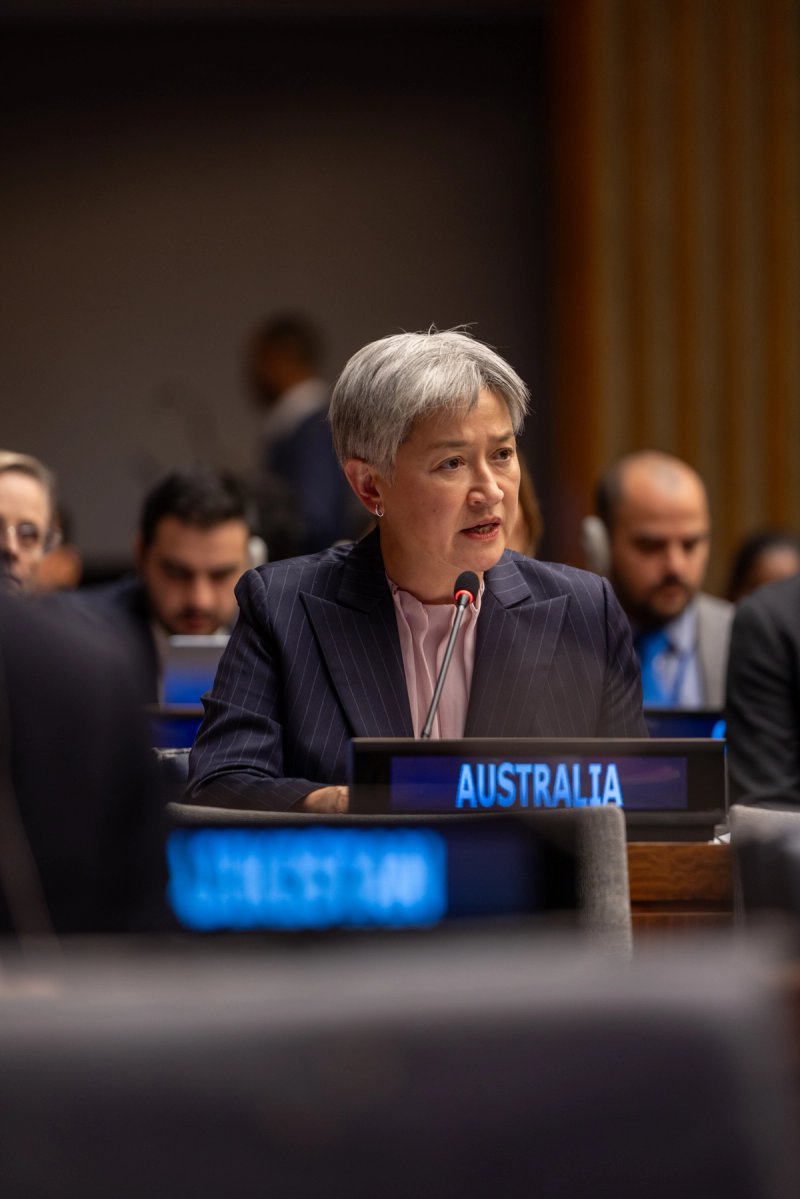
Foreign Minister Penny Wong (Miguel Gallagher/DFAT)
Into this space, Foreign Minister Penny Wong is set to give a speech (Opens in new window) that will place AI as a major foreign policy focus for Canberra, akin to the threat posed by nuclear weapons.
Australia has already shown healthy ambition in contesting Silicon Valley’s power within its own borders. Australia is seen around the world as a leader in regulating social media companies, the torchbearer of countries looking to exert their own influence over a faraway source of power.
Australia has a chance to redefine the power imbalance between middle powers and the AI industry by building a coalition of other countries. Together, they can pool resources and set out international rules together.
This is not a rejection entirely of American leadership. Australia is a signatory to Trump’s Pax Silica and is actively courting massive investment by American companies into Australia.
Wong, in her remarks, says that alliance with the United States gives “Australian strategic weight at precisely the moment we need every opportunity for influence available to us.”
But it is a recognition that there is no sustainable future in which every country cedes their technological sovereignty to a superpower.
Nor should this be something a rational US administration wants. A more dispersed AI industry among democratic nations is healthier, more robust, and has the best chance of winning the race against China.
Middle powers cannot rebuild an entire AI ecosystem, even in aggregate. They do have power in shaping how the industry works. That power is now taking the global stage.
Cory Alpert is a PhD researcher at the University of Melbourne, where he studies the impact of AI on democracy. Previously, he served in the Biden White House for three years and as the senior adviser to Mayor Steve Benjamin.