Panic buying food in Yogyakarta, October 1998 (W. Cusdida/AFP via Getty Images)
The financial crisis Asia failed to see
The late 1990s was a time of soaring expectations built on hidden rot.
Newsletters
Subscribe to The Informer for monthly expert analysis, and to Events for advance notice of visiting world leaders and distinguished guests.
You may unsubscribe from Lowy Institute newsletters at any time. For information on our privacy practices and how to unsubscribe, see our Privacy Policy.
Matthew Busch’s The Contested Statetells the story of the aftermath of Indonesia’s financial crisis of 1997-98. And what a dramatic and tragic tale it is. GDP down 13 per cent in a single year, mass capital flight, collapsed banks and many more nationalised, a currency torn from its US dollar peg and, eventually, mass layoffs, riots in the streets, and an end to the decades-long rule of General Suharto and his New Order regime.
Accessing sources hitherto locked away, The Contested State digs deep into Indonesia’s financial crisis but throughout runs the understanding, true everywhere but often missed, that a country’s financial affairs are a projection of its political and social settlement. This settlement was under great strain in Indonesia as the new millennia beckoned.
We know now that beneath this tidy and vital veneer lurked a financial sector that was mired in corruption and dysfunction.
The international community, Indonesia watchers, and even key local banking insiders were, as Busch puts it, caught “flat footed” by the speed and depth of Indonesia’s financial crisis. The country had been running persistent budget and trade surpluses, growth was strong and inflation manageable. Busch reminds us that before the crisis Indonesia did not even issue sovereign bonds. The government thought it didn’t need to. Though this might hint at the shallowness of the country’s financial markets, it was taken as a sign, along with the other metrics noted, that all was quiet on the macroeconomic front.
Of course, we know now that beneath this tidy and vital veneer lurked a financial sector that was mired in corruption and dysfunction. According to Busch, Indonesia’s banks were “under-regulated and over-guaranteed”, leading to a situation in which there were too many banks and yet an overconcentration of a few big conglomerate-owned banks with deep political connections. No formal deposit insurance scheme existed before the crisis, but for the connected bankers it was these political ties they thought would bail them out. Few banks bothered to hedge their foreign exchange exposures, which would be a key cause of bank insolvency once the rupiah went into free fall (by 1998 it had fallen 80 per cent against the dollar).
It was moral hazard with bells on.
Supervision of the sector at the Central Bank of Indonesia and elsewhere was “weak and politically subservient”. No surprise then that amidst all of this emerged just about all the maladies we have come to expect in banking crises – insufficient capital, low liquidity, related party lending, short-term and volatile funding (much of it from offshore), over-valued loan collateral, doubts over property titles, and incentive structures that pushed prudent risk management aside for growth at all costs.
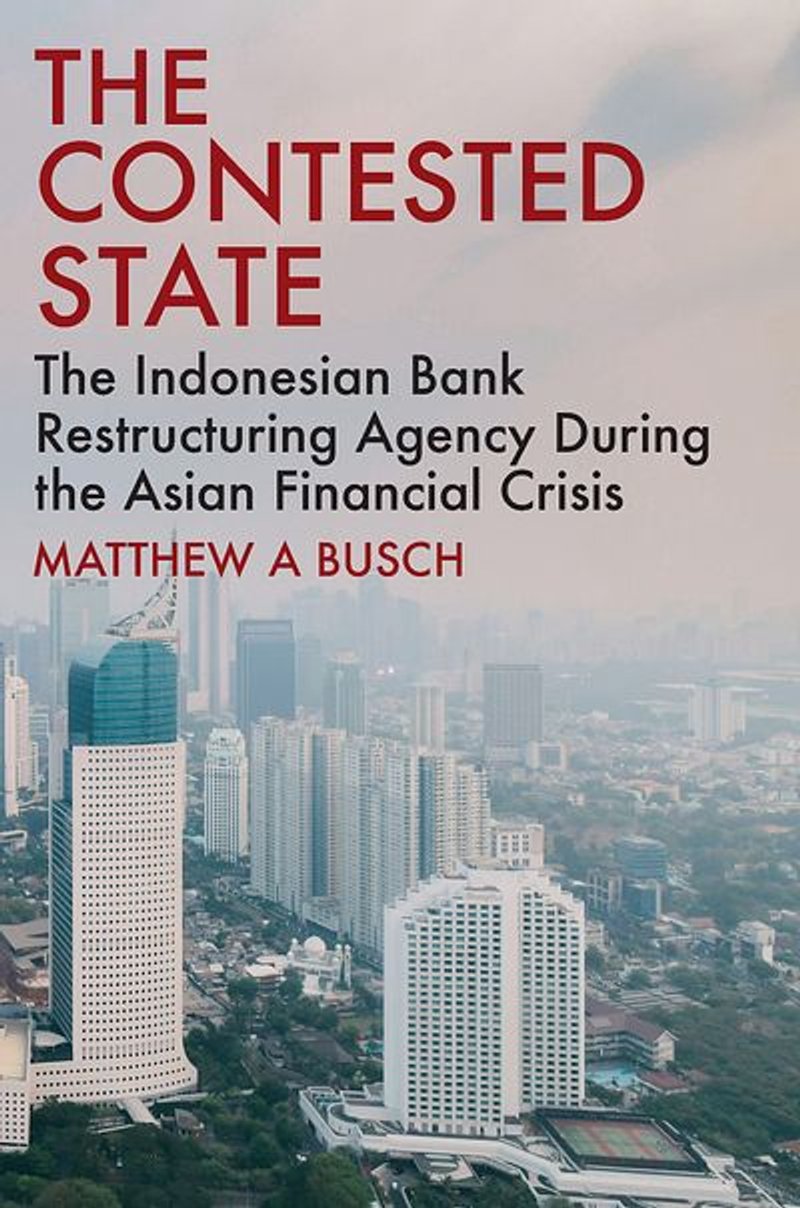
Cover of Matt Busch's The Contested State
The central actor in the drama played out in The Contested State is the Indonesian Bank Restructuring Agency (IBRA). Established in haste in January 1998, IBRA was not given the powers and legitimacy it needed. Given a mandate to stabilise and restructure the banking system, it was also expected to maximise the recovery of state funds used to keep banks afloat. In the end an estimated $US65 billion (60 per cent of GDP) was spent in rescuing the banks. IBRA recovered around $20 billion of this.
Also hampering IBRA was an understandable popular mood that the agency deliver punishment and retribution to the bankers who had caused it all. IBRA didn’t have any prosecutorial powers, so this did not happen. Finally, IBRA came into bad odour because of its collaboration with the IMF, fuelling “perceptions of IBRA as an alien, imposed measure to facilitate the fire sale of homegrown Indonesian assets”.
Busch defends IBRA in The Contested State, finding that notwithstanding the flaws in its construction it flexibly negotiated a highly contested and fluid political environment and got a “massive array of things done”.
Early in The Contested State Busch tells us to expect a “ripping yarn”. He delivers on his promise in a succinct 170 pages and gives us a judicious and wise account of the damage wrought from financial crises, and of the importance of the institutions we need to avoid them.
Matthew Busch, The Contested State: The Indonesian Bank Restructuring Agency During the Asian Financial Crisis (Melbourne University Press, 2025).
Sean Turnell is a Nonresident Fellow at the Lowy Institute. He was previously a Senior Fellow in the Southeast Asia Program, specialising in macroeconomic policy, economic reform, and Myanmar. From 2016 to 2021, he served as senior economic adviser to Myanmar's democratic government, and was subsequently imprisoned for 650 days following the February 2021 military coup.