Marsinah became a symbol of labour rights and social justice after being murdered in 1993, her likeness held aloft here during a protest organised on International Women's Day demanding labour rights, gender equality and protections, in Jakarta, 8 March 2025 (Yasuyoshi Chiba/AFP via Getty Images)
Indonesia’s National Hero titles and the politics of unresolved violence
Indonesia keeps honouring the victims of state violence only once their killers can no longer be prosecuted.
Newsletters
Subscribe to The Informer for monthly expert analysis, and to Events for advance notice of visiting world leaders and distinguished guests.
You may unsubscribe from Lowy Institute newsletters at any time. For information on our privacy practices and how to unsubscribe, see our Privacy Policy.
|Indonesia’s National Hero titles and the politics of unresolved violence
Indonesia’s National Hero titles and the politics of unresolved violence
As Indonesia approaches National Heroes Day (Hari Pahlawan) on 10 November, the decree naming this year’s National Heroes (Pahlawan Nasional) is, a deputy minister says, already on President Prabowo Subianto’s desk (Opens in new window). The title is the republic’s highest honour, awarded posthumously since 1959. Last year’s list, and a campaign to add a murdered journalist to the next one, show what the title does when it goes to victims of the state’s own violence.
Civil society demands the state recognition and accountability for past abuses. Whatever the government intends, the outcome has been consistent. The state grants the title once the criminal accountability is no longer legally possible.
The question is not only domestic. Indonesia chairs the UN Human Rights Council (Opens in new window) in 2026, and the government is drafting a revision (Opens in new window) of the 1999 Human Rights Law that could give the National Commission on Human Rights (Komnas HAM) investigative powers over the gravest cases. Whether a New Order killing can still reach a court is a live question.
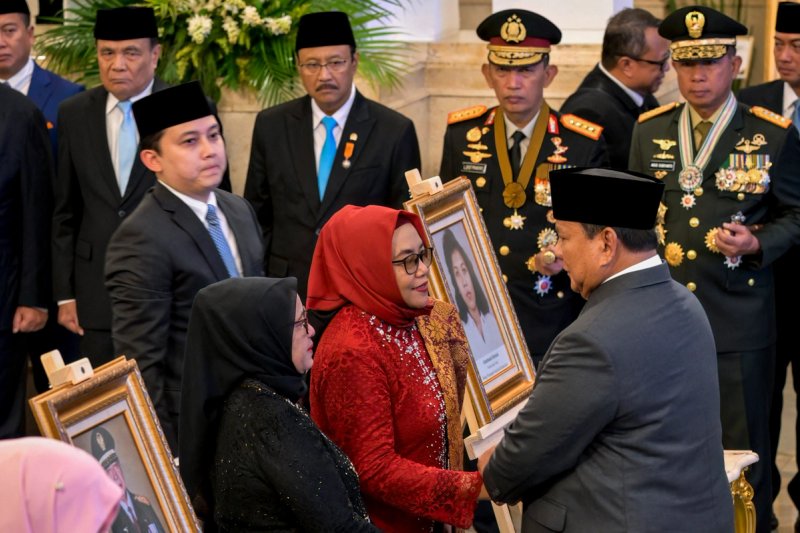
On 10 November 2025, Prabowo conferred the title on ten people, including Marsinah, a labour activist killed in 1993. When asked whether her murder investigation would now be reopened, State Secretary Prasetyo Hadi replied that the two matters were unconnected (Opens in new window): “Let us look forward together. Every generation has its time, every era has its people, its achievements, its strengths, its shortcomings.”
What is new in the cases from Suharto’s military-backed New Order is how the honour interacts with the clock of criminal procedure.
This not unprecedented, in 1963 Sukarno, Indonesia’s first president, conferred the title (Opens in new window) on Tan Malaka, a revolutionary executed by Republican troops in 1949. What is new in the cases from Suharto’s military-backed New Order (1966 to 1998) is how the honour interacts with the clock of criminal procedure.
The case of Marsinah perfectly illustrates this paradox. In May 1993 Marsinah, a 24-year-old worker at a watch factory in East Java, disappeared after a strike. Under the New Order the army policed labour disputes, and she went to the local military command to ask after colleagues interrogated there. Days later her body, bearing signs of torture, was found in a forest hut. The factory owner and several employees were convicted in 1994; the Supreme Court acquitted them all in 1995 (Opens in new window). No one has been charged since.
Her nomination came from below. Nganjuk, her home district, began the nomination in 2022 (Opens in new window), and on May Day 2025 Prabowo, a retired general and former son-in-law of Suharto, pledged his support (Opens in new window) on condition that union leaders agreed. The resulting decree formalised a stark historical irony. The decree that named her also named Suharto, under whose regime she was killed.
Anis Hidayah, who chairs Komnas HAM, the body that decides whether a case counts as a gross human rights violation eligible for a special court, welcomed the recognition while naming the paradox (Opens in new window): “The person is given a title, yet the case itself remains unresolved.”
Prabowo publicly admitted the structural violence behind her death. Opening a Marsinah museum on 16 May 2026, Prabowo said (Opens in new window): “I have only just realised and understood that collusion by security personnel was used by certain capitalists, and this is a culture we must not continue.”
The family of the late Marsinah, the labour activist murdered during former President Suharto's leadership, during a ceremony with President Prabowo Subianto held to mark the National Heroes Day at the State Palace in Jakarta, 10 November 2025 (Bay Ismoyo/AFP via Getty Images)
Under the old Criminal Code, in force until January 2026, prosecution for murder lapsed after 18 years, so Marsinah’s case expired in 2011. Only reclassification as a gross human rights violation, which carries no time bar, could reopen it. On 5 May 2026 a committee marking 33 years since her death went to Komnas HAM to demand that (Opens in new window). The commission refused and treats the killing as an ordinary crime, while claiming to have lost its 2013 investigation file.
A second New Order killing is now following the same dynamic. Journalists’ associations in Yogyakarta are nominating Fuad Muhammad Syafruddin, known as Udin, a reporter for the daily Bernas who was beaten to death in August 1996 (Opens in new window) after reporting on corruption in Bantul district. Police framed a local driver with a confession (Opens in new window) bought with alcohol and money; a court acquitted him in 1997.
With prosecution foreclosed, the press groups turned to the honours system. On 29 October 2026 Deputy Minister of Social Affairs Agus Jabo Priyono backed Udin’s candidacy (Opens in new window) for a later cycle; this year’s is closed. Should Udin be inducted, his widow would qualify under a 2018 presidential regulation (Opens in new window) (which, naming only spouses and children, appears to exclude Marsinah’s sisters) for a family allowance of 50 million rupiah (about US$2,800) a year.
Indonesia’s 2009 Law on Titles (Opens in new window) assesses a candidate’s service and example, remaining legally blind to the circumstances of death or the evasion of justice. By the time unions and press groups push a victim of New Order violence through district, provincial and ministerial review to the Council on Titles, the criminal calendar has run out. The state does not use the hero title to close the criminal file. It safely confers the title once the file is already closed. Whether that remains the only outcome depends less on the honours system than on what the revised Human Rights Law gives Komnas HAM, and whether a commission that that routinely “loses” its own investigation files is capable of enforcing them.
Dr Myra Mentari Abubakar holds a PhD from the Australian National University and is a Research Affiliate at the International Centre for Aceh and Indian Ocean Studies (ICAIOS). She researches the politics of heroism and state memory in Indonesia.