Indonesian firefighters trying to extinguish South Sumatran wildfires in September, with Australia since sending help to fight blazes in East Kalimantan (Muhammad Fajri/Anadolu via Getty Images)
Fighting fires, sparking curiosity
Australia’s fire-fighting mission in East Kalimantan may kindle wider interest in Indonesia.
Newsletters
Subscribe to The Informer for monthly expert analysis, and to Events for advance notice of visiting world leaders and distinguished guests.
You may unsubscribe from Lowy Institute newsletters at any time. For information on our privacy practices and how to unsubscribe, see our Privacy Policy.
Australia’s firefighting mission is practical neighbourliness. But could it also kindle interest in Indonesia among the firefighters, their colleagues, and communities?
A Hercules aircraft can drop 15,000 litres of water in seconds. Building Australians’ understanding of their diverse and consequential neighbour takes rather longer. This month’s firefighting deployment to Indonesia brings both propositions into focus.
Yet, while Reuters covered the mission (Opens in new window), much Australian reporting focused on a separate fatal helicopter crash (Opens in new window) in South Kalimantan. Indonesian media told more of the story of cooperation on the ground. What that reporting does not establish is the Indonesia capability of the 20 Australian specialists. We do not know whether the firefighters spoke Indonesian, had experience of Indonesia, received cultural preparation, or worked through interpreters. This is not evidence they lacked those skills. It is a gap in what the public has been told.
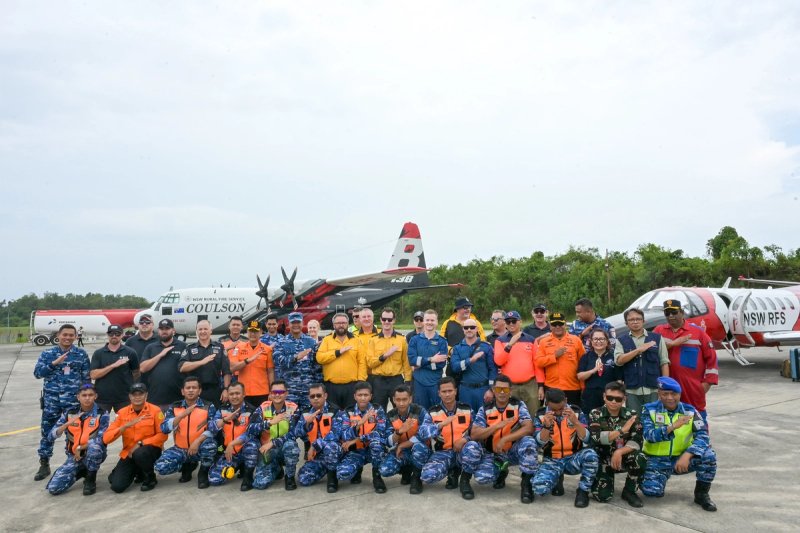
Crews in cooperation between Australia and Indonesia in tackling the ongoing forest fires in East Kalimantan, 5 November 2026 (Australian Embassy Jakarta/Flickr)
Such capability also matters operationally. Someone must understand local priorities and briefings, resolve misunderstandings, and build trust. Firefighting expertise and Indonesian-language or cultural expertise are not the same thing.
Potential gaps like these also matter beyond the fireground. A June parliamentary inquiry into Asia capability (Opens in new window) reported that domestic university enrolments in Southeast Asian languages had fallen 75 per cent from 2005 to 2024. Barely 500 domestic university students studied Indonesian. It warned that the pipeline supplying deeper understanding of our region was in crisis.
There is another way to think about this deployment’s contribution. The parliamentary report treats awareness-raising as one part of Asia capability. A week alongside Indonesians could offer exactly this first step. It does not, by itself, establish linguistic proficiency or deep cultural understanding. The inquiry also credits committed teachers with sustaining threatened language programs, notes their power to inspire continued learning, and describes how visits to Indonesia can ignite students’ interest in Indonesian. Those observations concern education, not firefighters, but they suggest a question worth asking beyond the classroom.
Could 20 Australians return to rural New South Wales curious about Indonesia, and pass that curiosity to their fellow firefighters, families, friends, and communities? A conversation at a brigade station, a visit to a local school, or an ongoing friendship with an Indonesian colleague might make learning Indonesian seem appealing. These are possibilities, not documented outcomes. It would be worthwhile discovering whether the 2009, 2015 or 2019 activities had these types of impacts.
Such diplomatic activities can be framed as about creating educational demand, replacing the tired narrative that learning Indonesian will help students get a job. A firefighter may never need Indonesian for a paid position. That is beside the point. People also learn languages because they meet someone, hear a story, visit a place, or find themselves wanting to understand a neighbour. Such interest may eventually sustain enrolments, including in places far from university campuses. It need not start with the promise of a better job.
There is a role for the NSW Rural Fire Service here. If returning personnel share their experiences with rural NSW brigades, local schools, and neighbours, one short mission could introduce Indonesia to Australians who rarely encounter it beyond news headlines. Follow-up exchanges or accessible community and online Indonesian classes would give that curiosity somewhere to go. A shared story might prompt a colleague or a firefighter’s child to study Indonesian, creating demand well beyond the original contingent. None of this requires pretending that a week away produces Indonesia specialists.
A useful post-mission review could thus ask not just what was dropped, but what was learned. Were new Australian–Indonesian collegial relations established? Did Australians want further contact or lessons? Could exchanges, short courses, or local community events turn awareness into sustained interest?
Helping a neighbour fight fires is valuable. Helping Australians discover why that neighbour is worth knowing could have effects long after the aircraft come home.